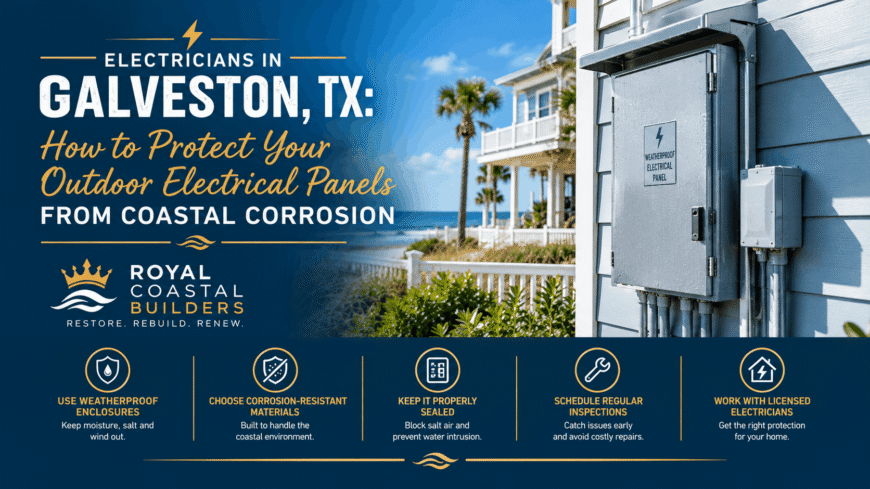
Electricians in Galveston, TX see a pattern repeat itself with enough regularity that it qualifies as one of the most predictable and preventable problems in coastal home ownership: an outdoor electrical panel that was installed without adequate protection against the Gulf Coast environment gradually succumbs to salt air corrosion, and the homeowner discovers the problem only when a breaker fails to reset, when a burning smell comes from the panel enclosure, or when a home inspection reveals a condition that makes the property uninsurable until the panel is replaced.
Galveston’s coastal environment is among the harshest in the United States for outdoor electrical equipment. The combination of salt-laden air from the Gulf of Mexico and Galveston Bay, persistent high humidity, intense UV radiation, and the direct salt water exposure that storm surge and flooding events deliver creates conditions that attack every metallic and polymer component in an outdoor electrical system simultaneously and continuously. A panel enclosure rated for standard residential outdoor use in San Antonio or Dallas begins to show corrosion evidence within twelve to eighteen months of installation in a direct coastal Galveston location — and can reach a condition of genuine safety risk within five to seven years if not properly specified, installed, and maintained.
This guide covers everything Galveston homeowners need to know about outdoor electrical panel corrosion — how it happens, what it compromises, how to evaluate your current panel’s condition, and what the right specification and protection strategies look like for the coastal environment.
How Salt Air Attacks Outdoor Electrical Panels
The degradation of an outdoor electrical panel in Galveston’s coastal environment is not a single event — it is a systematic electrochemical process driven by the same corrosion mechanisms described in our guide to saltwater intrusion and plumbing systems, applied to the components of an electrical distribution system.
The specific failure modes that salt air drives in outdoor electrical panels include:
Bus bar corrosion. The bus bars — the heavy copper or aluminum conductors that distribute power from the main breaker to the individual circuit breakers — are the highest-current components in the panel. In a salt air environment, copper bus bars develop a layer of copper chloride corrosion that increases electrical resistance at contact points, generating heat during normal operation. Aluminum bus bars oxidize rapidly in high-chloride environments, producing aluminum oxide films that further increase resistance and create hot spots that can progress to arc fault conditions. Elevated resistance at bus bar connections is one of the most common causes of unexplained heat, tripped breakers, and electrical fires in coastal homes with long-neglected panels.
Breaker contact corrosion. Individual circuit breakers contain internal contacts that make and break the circuit when the breaker trips or is manually operated. Corrosion on these contacts — driven by salt air infiltration into the breaker body — increases contact resistance, causes breakers to run warm, and eventually produces breakers that fail to hold a set position or fail to trip under overload conditions. A breaker that does not trip when it should is not a nuisance — it is a fire hazard.
Enclosure rust and perforation. The steel enclosure that houses the panel components is typically galvanized or zinc-coated at the factory. In Galveston’s coastal environment, the zinc sacrificial coating depletes through the same cathodic protection mechanism that drives anode rod depletion in water heaters — protecting the underlying steel until the zinc is consumed, then allowing rust to develop and progress to perforation. A perforated panel enclosure admits salt air, rain, and insects directly into the electrical components, accelerating every other failure mode simultaneously.
Terminal and lug corrosion. The terminals and lugs where service entrance conductors and circuit wiring connect to the panel components are the points of highest consequence in any electrical panel — a failed connection here is a direct arc fault risk. Copper wire terminals develop verdigris and copper chloride corrosion in salt air environments; aluminum service entrance conductors develop oxide films that require periodic cleaning and anti-oxidant compound application to maintain safe connections. These connection points are where the most serious safety consequences of corrosion manifest.
Conduit seal degradation. The conduit fittings and seals where wiring enters and exits the panel enclosure are the primary pathway for salt air infiltration into the panel interior. Standard conduit fittings and pull boxes are not rated for the continuous marine atmospheric exposure that Galveston coastal locations deliver. Seal degradation allows the coastal environment to reach components that the enclosure was meant to protect.
NEMA Enclosure Ratings — What They Mean for Galveston Panels
Understanding the NEMA (National Electrical Manufacturers Association) enclosure rating system is essential for evaluating whether an existing outdoor panel or a new installation is appropriately specified for a Galveston coastal location. NEMA ratings define the environmental protection level an enclosure provides:
- NEMA 3R — the most common rating for standard residential outdoor electrical panels. Provides protection against rain, sleet, and external ice formation. Does not provide protection against corrosive atmospheres. Appropriate for inland residential applications; not appropriate for direct coastal salt air exposure on Galveston Island.
- NEMA 4 — provides protection against windblown dust and rain, splashing water, and hose-directed water. Offers better sealing than 3R but still does not specifically address corrosive atmosphere protection.
- NEMA 4X — provides all of the NEMA 4 protections plus corrosion resistance. This is the minimum appropriate NEMA rating for electrical enclosures in direct coastal salt air exposure on Galveston Island. NEMA 4X enclosures are constructed from stainless steel, fiberglass, or other corrosion-resistant materials and maintain their integrity in marine atmospheric conditions that would destroy a NEMA 3R enclosure within a few years.
- NEMA 6P — provides protection against temporary submersion and corrosive atmospheres. Appropriate for electrical enclosures in Galveston flood zone locations where the enclosure may be submerged during storm surge events — though the preferred solution for flood zone electrical panels is elevation above the Base Flood Elevation rather than submersion-rated enclosures, as discussed in our FEMA Flood Maps guide.
The majority of outdoor residential electrical panels installed in Galveston’s existing housing stock carry NEMA 3R ratings — the standard residential outdoor specification. Identifying whether your current panel enclosure meets the NEMA 4X minimum standard for coastal salt air exposure is the first evaluation step in any coastal electrical panel assessment.
Evaluating Your Current Panel’s Corrosion Condition
Galveston homeowners can perform a basic visual assessment of their outdoor electrical panel’s corrosion condition, though a thorough evaluation requires a licensed electrician who can safely open the panel and inspect internal components. External indicators that a panel has sustained significant corrosion damage include:
- Surface rust on the enclosure exterior — particularly at edges, corners, and where the enclosure meets mounting brackets, where the zinc coating is thinnest and corrosion initiates first
- Rust staining on the wall surface below the panel — indicating that water is entering the enclosure and carrying rust particles out through the bottom as it drains
- Discoloration or staining around conduit entry points — indicating that the conduit fittings or seals have failed and are allowing moisture and salt air to enter the panel interior
- Difficulty operating the main breaker or individual breakers — stiff or sticky breaker operation is a mechanical indicator of internal corrosion on the breaker body and operating mechanism
- Visible corrosion on the panel door interior — the inside surface of the panel door is the easiest internal surface to inspect without removing the panel cover; corrosion deposits visible here indicate that the interior has been exposed to the coastal environment
When any of these indicators are present, a professional panel inspection by a licensed member of our electrical team is warranted before the condition progresses to a safety event. Internal inspection of an energized electrical panel requires training, appropriate personal protective equipment, and knowledge of the hazards involved — it is not a task for homeowners to perform without professional support.
Protection Strategies for New and Existing Outdoor Panels
For New Installation and Panel Replacement
When a coastal Galveston panel is being installed for the first time — whether in new construction or as a replacement for a failed existing panel — the specification decisions made at this stage determine how long the installation performs before requiring significant maintenance or replacement:
Enclosure material selection. A fiberglass or 316 stainless steel NEMA 4X enclosure is the appropriate specification for new outdoor panel installations within direct coastal salt air exposure range on Galveston Island. Fiberglass enclosures are non-conductive, dimensionally stable, impervious to salt air corrosion, and available in configurations that accommodate residential electrical panel components without modification. Stainless steel NEMA 4X enclosures provide equivalent environmental protection with greater mechanical durability for locations subject to impact from debris.
Panel location and orientation. Siting the panel on the leeward side of the structure — the side facing away from the prevailing Gulf breeze direction — reduces direct salt air deposition on the enclosure surface. Orienting the panel door away from prevailing weather exposure reduces the frequency of direct rain contact with the enclosure seams and conduit entries where water infiltration risk is highest.
Conduit system specification. All conduit connecting to a coastal outdoor electrical panel should be Schedule 80 PVC or liquid-tight flexible conduit with stainless steel fittings rather than standard EMT conduit — which corrodes rapidly in salt air and eventually perforates, creating both a pathway for salt air into the panel and a structural failure of the conduit system itself. PVC conduit is impervious to salt air corrosion and carries no metallic components at risk.
Corrosion-inhibiting compound at all connections. Anti-oxidant compound applied to all terminal connections — particularly at aluminum conductor terminations — prevents the oxide film formation that increases connection resistance over time. This is a standard installation practice that our electrical team applies to every coastal panel installation.
For Existing Panels — Extending Service Life
For Galveston homeowners with existing outdoor panels that are not yet at the end of their service life but are showing early corrosion indicators, several protective measures can meaningfully extend service life:
Corrosion-inhibiting spray treatment on accessible external surfaces. Marine-grade corrosion inhibitors applied to the exterior of the panel enclosure and to accessible conduit connections create a barrier layer that slows the salt air attack on the steel enclosure surface. This is a maintenance measure rather than a permanent solution — it requires periodic reapplication — but it is a cost-effective way to extend a panel’s remaining service life.
Conduit seal inspection and resealing. The entry points where conduit connects to the panel enclosure are the primary salt air infiltration pathways into the interior. Inspection of conduit fittings and application of appropriate weatherproof sealant around entry points closes the most common infiltration routes for coastal environments.
Desiccant placement in enclosed spaces. For panels in enclosed weatherhead or metered enclosures, desiccant packs that absorb ambient moisture within the enclosed air volume reduce the humidity level that drives internal corrosion. This is a supplemental measure rather than a primary defense, but it is useful in situations where full enclosure replacement is deferred.
Annual professional inspection. A licensed electrician’s annual inspection of the panel interior — including infrared scanning to identify hot spots at corroded connections, torque verification of terminal connections, and breaker operation testing — catches developing problems before they progress to safety events. Thermal imaging in particular identifies elevated-resistance connections that are invisible to visual inspection but represent a progressive arc fault risk.
When Panel Replacement Is the Right Answer
Several conditions indicate that panel corrosion has progressed to the point where replacement is more appropriate than continued maintenance:
- Visible corrosion on internal bus bars or breaker contacts identified during professional inspection
- Thermal imaging hot spots at multiple connection points indicating widespread resistance elevation from corrosion
- Enclosure perforation — a panel enclosure with rust-through holes cannot be adequately sealed against continued salt air intrusion
- Breaker failure under test — breakers that do not hold set position or that do not trip under simulated overload conditions must be replaced, and when multiple breakers in a panel show this failure mode, panel replacement is more economical than individual breaker replacement
- Panels over 25 years old in direct coastal exposure — regardless of visual condition, panels with this service history in Galveston’s salt air environment have reached a maintenance age where replacement with a properly specified coastal enclosure delivers better long-term value than continued investment in maintenance
Panel replacement in Galveston requires City of Galveston permits and inspection, and the service entrance work involved requires a licensed electrician. Our electrical team manages the full scope — from permit application through final inspection — and specifies replacement panels to the coastal standards that protect the installation for the next twenty-five years rather than simply replacing like for like.
For homes undergoing broader renovation or restoration work, panel replacement coordinates naturally with the scope covered in our water damage restoration guide and our post-storm restoration guide — open wall cavities and accessible electrical runs during restoration create the most cost-effective window for panel and conduit upgrades.
Outdoor Subpanels, Pool Equipment Panels, and Generator Transfer Switches
The main residential electrical panel is not the only outdoor electrical equipment vulnerable to coastal corrosion on a Galveston property. Several other outdoor electrical components deserve the same specification and maintenance attention:
Pool and spa equipment panels — if the property includes a pool or spa, the subpanel serving the pump, heater, and lighting circuits is typically located adjacent to the equipment in a highly exposed outdoor location. Pool equipment panels in Galveston should be specified to NEMA 4X standards and inspected annually given the combination of salt air and chlorine vapors from the pool water that creates an accelerated corrosion environment.
Generator transfer switches — standby generator installations include a transfer switch that is often located outdoors adjacent to the main panel. Transfer switches must be specified for the same coastal environment as the panel itself — a NEMA 3R transfer switch adjacent to a NEMA 4X main panel is a vulnerability in the system that undermines the investment in the properly specified main enclosure.
Outdoor subpanels for outbuildings, outdoor kitchens, and docks — any subpanel serving an outbuilding, a covered outdoor kitchen, a dock, or a detached garage on a Galveston coastal property should be specified to NEMA 4X standards regardless of whether the structure feels “protected.” Salt air reaches all outdoor locations on Galveston Island with sufficient concentration to drive the corrosion failures described above within the standard service life of a panel.
The National Electrical Manufacturers Association provides detailed enclosure type specifications and selection guidance that electricians and homeowners can reference when evaluating whether existing or proposed enclosures meet the requirements for specific coastal installation environments.
The Cost of Ignoring Outdoor Panel Corrosion in Galveston
The financial case for proactive outdoor panel protection and maintenance in Galveston is straightforward. A NEMA 4X replacement panel installation costs meaningfully more than a standard NEMA 3R installation — typically in the range of several hundred to a few thousand dollars more depending on the service size and scope. That premium is recovered many times over when compared against the alternative:
- An emergency panel replacement precipitated by a safety event — typically performed under less favorable scheduling conditions and often coinciding with other damage repair costs
- The fire damage that an arc fault event in a corroded panel produces — and the restoration costs that follow, as our fire restoration guide documents in detail
- The insurance consequences of a home inspection that identifies a panel condition requiring immediate remediation before coverage continues
According to the Electrical Safety Foundation International, electrical failures are among the leading causes of residential fires in the United States, with faulty wiring and electrical equipment — categories that include corroded panel components — accounting for a significant share of those events.
Electricians in Galveston, TX who work regularly in the coastal market understand this risk calculus well. The recommendation to specify correctly at installation and maintain proactively is not conservative caution — it is the practical conclusion of watching what happens when coastal electrical panels are not given the protection the Gulf Coast environment requires.
Ready to have your outdoor electrical panel inspected or upgraded for Galveston’s coastal environment? Contact Royal Coastal Builders at (409) 996-2273 or visit royalcoastalbuilders.com/contact to schedule an electrical assessment with our coastal team today.