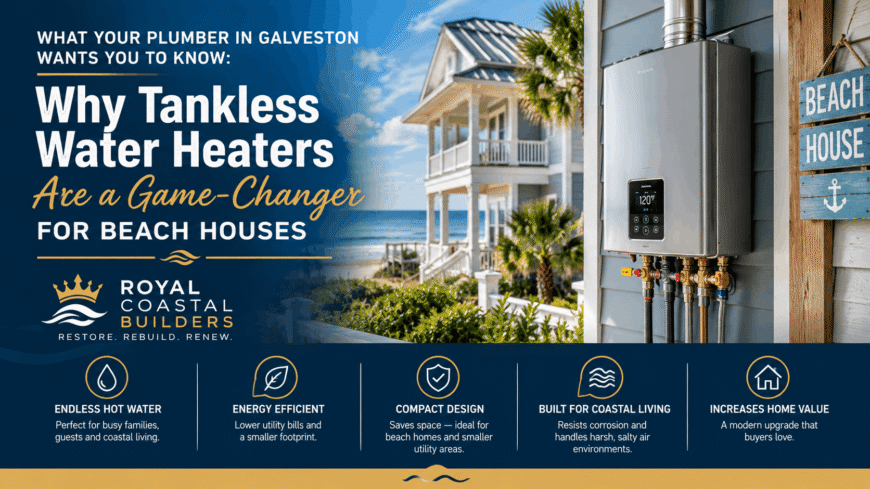
When homeowners ask a plumber in Galveston what single plumbing upgrade delivers the greatest long-term value in a Gulf Coast beach house, the answer is almost always the same: replace the tank water heater with a tankless unit. It is a recommendation that comes from years of watching tank-style water heaters fail prematurely in Galveston’s corrosive coastal environment, serve beach house occupants poorly during peak-demand gatherings, and sit idle for weeks at a time quietly consuming energy and corroding from within while the property sits unoccupied between visits.
Tankless water heaters address each of these problems — and they do it in a package that is smaller, longer-lasting, and more compatible with the specific patterns of beach house living than any tank-style alternative. For Galveston homeowners who have not yet made this transition, or who are planning a new build or renovation and are evaluating water heating options, this guide covers everything you need to know: how tankless systems work, why they outperform tank units in the coastal environment, how to choose the right system for your beach house, and what installation on Galveston Island requires.
How Tankless Water Heaters Work — and Why It Matters for Beach Houses
A conventional tank water heater maintains a reservoir of pre-heated water — typically 40 to 80 gallons — at a set temperature around the clock. Whether or not anyone is using hot water, the tank is constantly reheating water that loses heat through the tank walls to the surrounding space. This standby heat loss is the fundamental inefficiency of tank-style water heating, and it runs continuously whether the home is fully occupied or has been sitting empty for three weeks between visits.
A tankless water heater — also called an on-demand water heater — operates on a fundamentally different principle. When a hot water tap opens anywhere in the home, a flow sensor activates a high-powered burner or heating element that heats water as it passes through a heat exchanger, delivering hot water continuously at the set temperature for as long as the tap is open. When the tap closes, the heater shuts off completely — consuming no energy until hot water is needed again.
For a Galveston beach house, this distinction matters in several specific ways that do not apply equally to a full-time primary residence. A beach house may sit unoccupied for five days out of seven, three weeks at a stretch, or an entire off-season. During every hour of that idle time, a conventional tank water heater is cycling on and off to maintain temperature in a tank that nobody is drawing from. A tankless water heater idles at near-zero energy consumption during the same period — consuming only the minimal power required to maintain the electronic controls and, in some gas models, the pilot light.
The Department of Energy estimates that tankless water heaters can be 24 to 34 percent more energy-efficient than conventional storage tank heaters for homes that use 41 gallons or less of hot water per day — a usage profile that describes a Galveston beach house during most of its occupied periods and during all of its unoccupied ones.
Why Tank Water Heaters Fail Faster in Galveston’s Coastal Environment
The case for tankless is strongest in Galveston not just because of energy efficiency, but because of how poorly tank-style water heaters hold up in the Gulf Coast environment — a failure mode covered in our guide to common plumbing problems caused by saltwater intrusion.
The accelerated failure sequence for tank water heaters in Galveston is driven by two compounding factors:
Mineral content in Galveston’s water supply accelerates sediment accumulation on the tank floor and accelerates anode rod depletion. The sacrificial anode rod — the magnesium or aluminum rod suspended inside the tank whose sole purpose is to corrode preferentially and protect the tank lining — depletes in two to three years in Galveston’s high-mineral water, compared to four to six years in moderate-mineral inland supply. Once the anode rod is fully depleted, nothing stands between the corrosive water and the steel tank lining. The tank begins to corrode from within, and the homeowner typically discovers this only when rust-colored hot water appears, a leak develops, or the tank fails completely.
Salt air corrosion on the exterior attacks the tank shell, the flue connections on gas models, and the electrical components on electric models from outside simultaneously. A tank water heater in a coastal mechanical room or utility space — particularly in a Galveston home with any degree of ambient air exchange with the exterior — experiences corrosion on two fronts at once, accelerating the timeline to failure beyond what either factor would produce alone.
The result is a realistic service life of seven to ten years for a tank water heater in Galveston’s coastal environment — compared to the twelve to fifteen year life expectancy the same equipment delivers in a moderate inland environment. Tankless water heaters, by contrast, carry a practical coastal service life of fifteen to twenty years or more, because they have no tank to corrode and because their compact heat exchanger is more easily maintained and protected than a large-volume tank assembly.
Tankless Advantages Specific to Beach House Living
Beyond energy efficiency and corrosion resistance, tankless water heaters address several specific challenges of beach house water demand that tank-style units handle poorly:
Unlimited Hot Water for Peak-Demand Events
A tank water heater holds a finite volume of hot water. In a beach house where eight to twelve people arrive for a long weekend, the morning shower rotation can exhaust a 50-gallon tank before half the household has showered — leaving later risers with cold water and a forty-five minute recovery wait while the tank reheats.
A properly sized tankless system has no recovery wait. It heats water on demand at whatever flow rate the plumbing system is drawing, continuously, for as long as needed. For Galveston beach houses that host large groups regularly, this is not a minor convenience — it is a meaningful quality-of-life difference that guests notice and remember.
Right-Sizing for Actual Occupancy Patterns
A Galveston beach house that sleeps ten guests on summer weekends may have two occupants on a Tuesday in February. A 50-gallon tank water heater sized for the peak-demand scenario is massively oversized for the low-demand scenario — and pays the energy penalty for that oversizing in standby heat loss during every low-demand period.
A tankless system does not carry this penalty. It delivers exactly the capacity the current demand requires — no more, no less — making it inherently right-sized for the variable occupancy patterns that define beach house living.
No Damage from Extended Idle Periods
A tank water heater left at full operating temperature during an extended unoccupied period in Galveston’s warm climate is simultaneously wasting energy heating water nobody is using and accelerating the internal corrosion and bacterial growth conditions that develop in stagnant hot water. Setting the thermostat to a low vacation mode reduces energy waste but creates conditions in the warm standing water that are favorable for Legionella bacteria growth.
A tankless water heater set to vacation mode or turned off entirely during unoccupied periods has no standing water to become stagnant, no energy waste from maintaining temperature, and no bacterial growth concern. When the home is re-occupied, it delivers hot water within seconds of the first tap opening — with no reheating wait, no flush-and-purge requirement, and no stagnation concern.
Choosing the Right Tankless System for Your Galveston Beach House
Selecting a tankless water heater for a Galveston beach house involves several decisions that are specific to the coastal environment and the occupancy patterns of vacation property:
Gas vs. Electric Tankless
The choice between gas and electric tankless water heaters is largely determined by what fuel source is available at the property and by the simultaneous hot water demand the household needs to meet:
- Gas tankless water heaters — powered by natural gas or propane — deliver higher flow rates than electric units at equivalent installation costs, making them better suited to larger beach houses with multiple bathrooms and simultaneous demand from showers, kitchen, and laundry. Gas units require proper venting to the exterior, which adds installation complexity but is straightforward in new construction and manageable in most renovation contexts. In Galveston’s coastal environment, specifying stainless steel venting rather than standard aluminum eliminates the salt air corrosion failure that aluminum vent components experience at flue terminations exposed to coastal air.
- Electric tankless water heaters — which use high-wattage resistance elements rather than a combustion burner — have lower flow rates per unit than gas models but require no venting, making them simpler to install and well-suited to smaller beach houses or as point-of-use units serving a single bathroom or outdoor shower. Electric tankless units have no combustion components to corrode in the salt air environment, which is a durability advantage in exposed installation locations.
For most Galveston beach houses with natural gas service and multiple bathrooms, a whole-house gas tankless unit is the stronger recommendation. For smaller properties or those on propane where gas costs are higher, a high-capacity electric unit or a multi-unit electric configuration serves the demand well.
Flow Rate Sizing — Getting This Right
The most common sizing error in tankless water heater installation is selecting a unit based on the number of bathrooms rather than the actual simultaneous flow demand the household will place on it. Flow rate — measured in gallons per minute (GPM) — is the correct sizing metric for a tankless system.
A properly sized Galveston beach house tankless system accounts for:
- The number of showers likely to run simultaneously during peak morning demand — a standard showerhead flows at 1.5 to 2.5 GPM; a rainfall or dual-head shower can flow at 3 to 5 GPM
- Kitchen faucet demand during meal preparation — typically 1.5 to 2 GPM
- Laundry washing machine demand if hot water is used — typically 1.5 to 3 GPM
- The groundwater inlet temperature in Galveston — warmer inlet water requires less heating energy per gallon and increases effective flow rate capacity; Galveston’s relatively warm Gulf Coast groundwater temperatures provide a meaningful flow rate advantage compared to northern climates
For a Galveston beach house that sleeps six to ten guests with two to three bathrooms, a gas tankless unit with a 7 to 10 GPM capacity at Galveston’s inlet temperatures typically provides adequate simultaneous hot water for all reasonable peak demand scenarios. Our plumbing team performs the load calculations that confirm the right sizing for each specific property rather than applying rules of thumb that routinely undersize or oversize the equipment.
Scale Prevention for Galveston’s Mineral-Content Water
One of the maintenance considerations specific to tankless water heaters in Galveston is mineral scale accumulation in the heat exchanger. The same high mineral content in Galveston’s water supply that accelerates tank corrosion also deposits scale on the internal surfaces of a tankless heat exchanger — reducing thermal efficiency and eventually restricting flow if not managed.
The solutions that protect tankless heat exchangers from Galveston’s mineral content include:
- Annual descaling maintenance — flushing the heat exchanger with a food-grade descaling solution using a circulation pump kit, removing accumulated mineral deposits before they restrict flow or reduce efficiency. This is a straightforward annual maintenance task that our plumbing team performs as part of coastal plumbing maintenance programs.
- Whole-home water softener — addressing the mineral content at the point of entry rather than managing its downstream effects. A water softener that reduces total dissolved solids and hardness minerals before water reaches the tankless unit extends heat exchanger life and reduces the frequency of descaling service required.
- Inline sediment filter at the tankless unit cold water inlet — capturing particulates before they enter the heat exchanger and contributing to scale buildup
These maintenance measures are considerably simpler and less expensive than the anode rod replacement, tank flushing, and eventual tank replacement that a conventional water heater requires in Galveston’s mineral-content water environment.
Hot Water Recirculation Systems — Pairing with Tankless for Beach House Comfort
One limitation that beach house owners sometimes identify with tankless water heaters is the delay in hot water delivery at fixtures that are distant from the unit — the time it takes for hot water to travel through the cold supply line from the tankless unit to a remote bathroom or outdoor shower. In a large beach house, this delay can be fifteen to thirty seconds or longer.
A hot water recirculation system eliminates this delay by maintaining a loop of hot water from the tankless unit through the supply lines and back, so that hot water is available at every fixture almost immediately when a tap opens. Recirculation systems designed for tankless water heaters use demand-activated or timer-controlled circulation pumps rather than continuous circulation — avoiding the energy waste of pumping hot water continuously through lines where nobody is drawing.
For Galveston beach houses with multiple remote bathrooms, outdoor showers, and kitchen areas distant from the mechanical room, a demand-activated recirculation system paired with a properly sized tankless unit provides essentially instantaneous hot water delivery throughout the home — a guest experience that matches the quality of the best hotel amenities without the complexity or energy cost of a conventional recirculation loop.
What Tankless Installation in Galveston Requires
Installing a tankless water heater in a Galveston beach house involves coordination across several systems that a qualified coastal plumber manages from specification through commissioning:
- Gas line capacity assessment — tankless gas units have higher BTU demand than the tank-style units they replace, often requiring gas line upsizing from the meter to the unit location. This is a permit-required scope item that must be evaluated before equipment selection to avoid discovering that the existing gas line cannot support the selected unit.
- Electrical requirements — all tankless units require electrical service for controls and ignition, and high-capacity electric tankless units require dedicated 240V circuits that may necessitate electrical panel upgrades in older Galveston homes. Coordination with our electrical team on panel capacity is a standard step in our tankless installation process.
- Venting for gas models — direct-vent or power-vent configurations are both appropriate for Galveston installations, with stainless steel vent components specified for all exterior terminations exposed to salt air
- Code compliance and permits — water heater replacement and new installation in Galveston requires City of Galveston permits and inspection. Our licensed plumbing team manages the permit process as part of every installation.
- Mounting and clearance requirements — tankless units mount to the wall in a fraction of the footprint of a tank unit, and their compact profile opens up mechanical room space or enables installation in locations where a tank would not fit
The Long-Term Value of Going Tankless in Your Galveston Beach House
When you add up the energy savings from eliminating standby heat loss during occupancy and unoccupied periods, the extended equipment life compared to tank-style units in Galveston’s coastal environment, the elimination of tank failure and the water damage events that follow, and the improved hot water availability during peak-demand gatherings, the long-term value of a tankless water heater in a Galveston beach house is compelling.
Any experienced plumber in Galveston who has replaced corroded tank units, responded to tank failure flooding events, and fielded complaints about cold showers during family reunion weekends understands why the tankless recommendation is not a upsell — it is the straightforward right answer for a beach house on the Texas Gulf Coast.
Ready to upgrade to tankless hot water in your Galveston beach house? Contact Royal Coastal Builders at (409) 996-2273 or visit royalcoastalbuilders.com/contact to schedule a consultation with our Galveston plumbing team today.