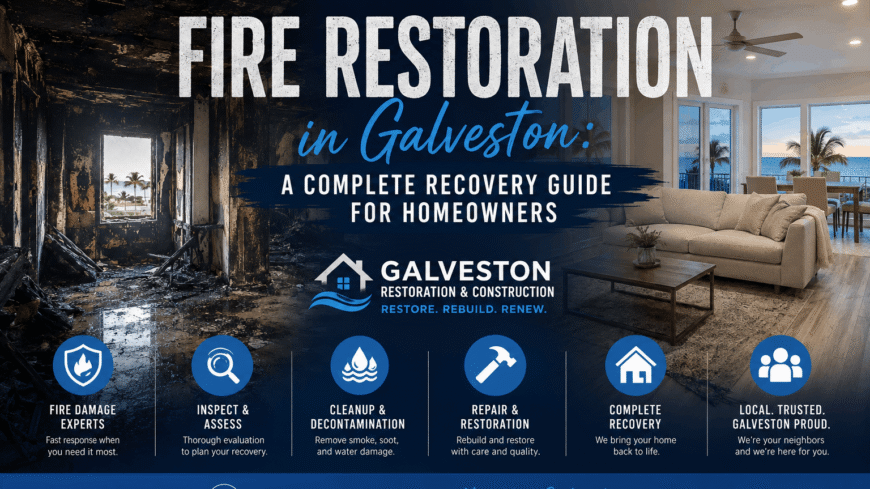
Fire restoration in Galveston requires the same urgency, precision, and professional expertise as any other disaster recovery process — and it introduces a unique set of technical challenges that are distinct from flood or storm damage in ways that every affected homeowner needs to understand. When a fire damages a Galveston home, the visible destruction from flames is only one dimension of the problem. Smoke, soot, heat, firefighting water, and the chemical byproducts of combustion affect every surface and system in the structure — often far beyond the area where fire was directly present — and every hour of delay in beginning the professional restoration process compounds the damage.
On the Texas Gulf Coast, fire recovery carries additional complexity. Galveston’s persistent humidity accelerates the corrosion and staining processes that soot and smoke residue initiate on surfaces and metal components. Salt air compounds the chemical reactions that make smoke residue so damaging to finishes, electronics, and structural metals. And the same elevated moisture environment that defines coastal living means that the water used to suppress a fire creates secondary damage risks — mold, structural degradation, and system corrosion — that inland fire recoveries manage with more time and less urgency.
This guide covers the complete fire restoration process for Galveston homeowners, from the immediate post-fire steps through smoke and soot remediation, structural assessment, contents restoration, and the rebuild that returns a fire-damaged home to full condition.
Understanding the Four Types of Fire Damage
Before any restoration work begins, it is essential to understand that fire damage is not a single phenomenon. The recovery process addresses four distinct damage types, each of which requires different remediation approaches:
Flame and Char Damage is the most visible — direct combustion of building materials, structural elements, and contents. Charred framing, burned cabinetry, destroyed roofing, and consumed wall assemblies are the immediate products of the fire itself. Structural char assessment determines which elements can be cleaned and retained and which require replacement.
Smoke Damage extends throughout the entire structure, carried on convection currents the fire created. Smoke penetrates wall cavities, ductwork, attic spaces, and the contents of rooms that never experienced direct flame. In a Galveston home, smoke residue on metal surfaces begins oxidizing — forming permanent staining — within hours in the humid coastal environment.
Soot Damage is the particulate residue deposited on surfaces by incomplete combustion. Soot chemistry varies based on what burned — synthetic materials produce a dry, powdery soot that smears when disturbed; proteins from food produce a yellow-brown, sticky soot that is particularly difficult to remove; and wet or synthetic materials produce a thick, oily soot that penetrates porous surfaces aggressively. Identifying soot type is the first step in selecting the correct cleaning methodology.
Water Damage from Firefighting is the secondary damage category that surprises many homeowners. The volume of water used in structural fire suppression — from fire department hose lines and, in many modern homes, from sprinkler systems — can exceed the water volume from a significant flood event. This water damage requires the same extraction, structural drying, and mold prevention protocols described in our water damage restoration guide, applied concurrently with the fire and smoke remediation process.
Step 1: Do Not Re-Enter Until Cleared
The period immediately following a structural fire requires particular restraint about re-entry. A fire-damaged structure presents hazards that are not visible to the untrained eye and that become more dangerous before they become less so:
- Structural instability. Fire compromises the load-bearing capacity of wood framing, engineered lumber, and metal connections in ways that are not always apparent from the exterior. A structure that appears intact after a fire may have framing members that have lost significant structural capacity and are at risk of sudden failure.
- Air quality hazards. Post-fire air in an unventilated structure contains a complex mixture of combustion byproducts — carbon monoxide, hydrogen cyanide, volatile organic compounds, and fine particulates — at concentrations that present acute health risks with brief exposure.
- Utility hazards. Electrical wiring, gas lines, and plumbing that passed through fire-affected areas may be compromised in ways that create fire re-ignition, explosion, or electrocution risks. Do not restore utilities to a fire-damaged home until all affected systems have been inspected and cleared by licensed professionals.
- Smoldering materials. Fire can persist in concealed spaces — wall cavities, attic assemblies, beneath flooring — long after visible flames are extinguished. Re-entry before fire department clearance risks disturbing smoldering materials and triggering re-ignition.
Wait for official clearance from the Galveston Fire Department before entering the property for any purpose, including documentation. When clearance is granted, wear appropriate respiratory protection and limit time in the structure until ventilation is established.
Step 2: Document Everything for Insurance
As with any disaster event affecting a Galveston home, comprehensive documentation before any cleanup or remediation begins is the foundation of your insurance claim. For fire damage specifically:
- Photograph and video all flame and char damage in every affected area, with timestamps active — including structural elements, finishes, built-ins, and contents
- Document smoke and soot deposits on walls, ceilings, and contents throughout the entire structure, including areas beyond the fire origin zone
- Photograph all firefighting water damage — soaked flooring, wet walls, submerged areas, and water-damaged contents
- Document all HVAC registers, ducts, and mechanical equipment that may have received smoke or soot through the ventilation system
- Inventory all personal property and contents in every area of the home, including items that appear undamaged — smoke and soot damage to contents is not always visually apparent immediately, but the insurance claim window for contents coverage typically runs from the date of loss
Do not discard any damaged items before your insurance adjuster has completed their inspection. Even significantly burned or destroyed items are evidence that supports the scope and value of your contents claim.
Contact your homeowners insurance company as soon as possible after fire department clearance. For a comprehensive overview of the insurance claim navigation process after a disaster event, our post-storm restoration guide covers the claims process in detail — the same principles apply to fire damage claims.
Step 3: Emergency Board-Up and Weatherization
A fire-damaged Galveston home with compromised exterior walls, a damaged roof, or broken windows is immediately exposed to the Gulf Coast environment — and in Galveston’s climate, that exposure initiates secondary damage processes within hours. Emergency weatherization is the first active step in the restoration process:
- Board-up of all compromised openings — broken windows, door openings, and wall penetrations — to prevent unauthorized entry, additional weather exposure, and wildlife intrusion
- Emergency roof tarping over any compromised roof sections, using properly secured tarps that will withstand Gulf Coast wind conditions rather than lightweight consumer tarps that fail in the first weather event
- Fencing or barricade installation where structural instability requires keeping unauthorized persons away from the immediate perimeter
In Galveston’s humid, salt-air environment, the window between initial fire damage and the onset of accelerated secondary degradation — rust on exposed metal, mold in firefighting water-soaked materials, UV degradation of exposed structural elements — is significantly shorter than in a dry inland climate. Emergency weatherization performed within the first 24 hours after fire department clearance is one of the most cost-effective actions in the entire restoration process.
Costs for emergency board-up and tarping are typically covered under the emergency mitigation provisions of a homeowners insurance policy. Document all work performed and retain all receipts before submitting to your insurer.
Step 4: Smoke and Soot Remediation — The Most Technical Phase
Smoke and soot remediation is the phase of fire restoration that most clearly separates professional restoration from amateur cleanup attempts — and where the largest share of secondary damage from incorrect technique occurs. Soot that is disturbed without the correct cleaning methodology spreads rather than removes, permanently staining surfaces that could have been cleaned with the right approach. Smoke odor that is masked rather than neutralized returns as conditions change, making the home unlivable even after structural repairs are complete.
Soot Type Identification and Cleaning Methodology
Professional fire restoration begins with identifying the soot types present in each affected area, because the cleaning chemistry and technique that removes one type of soot can set another:
- Dry soot from fast-burning materials responds to dry sponge methods and HEPA vacuuming before any wet cleaning is applied — wetting dry soot before vacuuming smears it into the surface
- Wet or oily soot from slow-burning synthetic materials requires alkaline cleaning agents that cut through the oily residue — the same dry sponge approach used on dry soot leaves wet soot intact
- Protein soot from kitchen fires is nearly invisible but produces the most persistent odor of any soot type, requiring enzymatic cleaning agents specifically formulated to break down protein-based residue
In most residential structure fires, multiple soot types are present — requiring a structured assessment of what burned in each zone before any cleaning begins.
Smoke Odor Neutralization
Smoke odor is not a surface phenomenon. The volatile organic compounds that produce smoke odor penetrate porous building materials — drywall, wood framing, insulation, flooring, soft furnishings — and continue to off-gas long after all visible soot has been removed. In Galveston’s humid climate, elevated moisture levels in the air accelerate the odor release from these materials, making smoke odor persistence a more significant issue in coastal fire restoration than in dry climate recoveries.
Professional smoke odor neutralization uses technologies that address the odor at the molecular level rather than masking it:
- Thermal fogging — a deodorizing agent dispersed as a heated fog that penetrates the same pathways smoke traveled, reaching into wall cavities, subfloor systems, and other areas inaccessible to surface cleaning
- Hydroxyl generation — hydroxyl radicals produced by UV light react with and permanently neutralize odor-producing VOCs throughout the air volume of the structure, without requiring occupant evacuation during treatment
- Ozone treatment — used in unoccupied spaces, ozone oxidizes odor-producing compounds on surfaces and in the air, but requires complete evacuation during treatment and careful post-treatment ventilation
For Galveston homes, thermal fogging and hydroxyl generation are typically preferred over ozone for occupied properties and vacation homes where rapid return-to-use is a priority, as they present fewer re-entry timing constraints.
HVAC System Decontamination
The HVAC system is a smoke and soot distribution pathway that must be addressed in every structural fire restoration — regardless of whether the fire was near the air handler. Smoke drawn into return air registers during the fire is deposited on coil surfaces, distributed through ductwork, and deposited on supply register diffusers throughout the entire home. Operating the HVAC after a fire without first decontaminating the system redistributes smoke residue and odor-producing compounds through every room with every cycle.
Our HVAC team performs complete post-fire HVAC assessments — including coil cleaning, duct inspection, and filter replacement — before any mechanical system is returned to service after a fire event.
Step 5: Structural Assessment and Char Depth Evaluation
Once smoke and soot remediation is underway, a structural assessment determines the full extent of flame and heat damage to the building’s structural systems. This assessment goes beyond visible charring to evaluate the structural capacity of affected elements:
Wood Framing
Wood framing that has been charred by fire loses structural capacity at a rate proportional to char depth. The CHAR Method — a standard engineering approach for evaluating fire-damaged wood — removes char to expose the underlying wood and assesses residual cross-section. Framing that retains sufficient uncharred cross-section can be cleaned, treated, and retained; framing with excessive char depth or structural failure must be replaced.
In Galveston’s humid environment, a critical additional factor is pre-existing moisture content and biological condition of the framing. Charred framing that was already compromised by moisture or prior biological activity before the fire may have less residual capacity than the char depth assessment alone would suggest — requiring a more conservative replacement threshold than a dry-climate structural assessment.
Roof and Structural Systems
Roof systems that have sustained direct flame exposure require assessment for decking integrity, rafter or truss damage, and ridge and hip connection condition. Our roofing team conducts post-fire roof assessments that evaluate structural condition beyond the visible surface, identifying areas of decking delamination, connection failure, and framing compromise that require replacement before any new roofing system is installed.
Electrical, Plumbing, and Mechanical Systems
All three systems require comprehensive inspection after a structural fire:
- Electrical: Heat and flame exposure compromises wire insulation, panel components, and connection integrity throughout the affected areas. Our electrical team assesses all wiring, panels, and connections in fire-affected zones before any system is re-energized.
- Plumbing: Copper and PVC piping in fire-affected areas may have sustained heat damage affecting pressure integrity. Plastic supply lines and drain components are particularly vulnerable to heat deformation. Our plumbing team inspects all system components in and adjacent to fire-affected zones.
- HVAC: Beyond the decontamination scope covered above, heat exposure to refrigerant lines, condenser components, and air handler components in fire-affected areas may require equipment replacement rather than cleaning.
Step 6: Contents Restoration and Pack-Out
Contents restoration — the cleaning, deodorization, and restoration of personal property, furnishings, and movable items — is a parallel track to structural restoration that requires its own professional scope. For Galveston homeowners, the decision between contents restoration and contents replacement is both a financial and a practical one.
Professional contents restoration can successfully clean and deodorize items that appear beyond recovery — upholstered furniture, artwork, clothing, documents, electronics, and decorative objects — when the right techniques are applied promptly. The two standard approaches are:
- On-site cleaning of larger items that cannot be readily moved, using the soot type-specific cleaning methodologies and odor neutralization techniques described above
- Pack-out and off-site restoration of contents moved to a controlled environment facility for more intensive cleaning, deodorization, and drying — typically used for items with significant value or for homes where the entire structure requires simultaneous restoration that would conflict with on-site contents cleaning
For Galveston vacation and beach homes, pack-out is often the more practical approach — it clears the structure for concurrent remediation and rebuilding work while protecting contents in a controlled environment rather than in a partially remediated coastal home with ongoing humidity exposure.
The Insurance Institute for Business and Home Safety provides homeowner resources on contents documentation and restoration claims that are useful for Galveston homeowners navigating the scope and valuation of a fire damage contents claim.
Step 7: Rebuilding with Fire-Resistance in Mind
The rebuilding phase of fire restoration is the opportunity to address the factors that contributed to fire spread and damage severity — and to incorporate fire-resistant materials and systems that reduce risk for the future.
In Galveston’s coastal environment, several fire-resistance improvements integrate naturally with the construction standards that the coastal environment already demands:
- Fiber cement siding — already recommended for coastal salt air resistance — is also non-combustible, providing a meaningful fire-resistance improvement over wood-based exterior cladding
- Metal roofing — already the preferred choice for Gulf Coast wind and longevity performance — is also Class A fire rated, the highest fire resistance classification for roofing materials. Our previous guide to metal roofing for coastal Texas homes covers its full range of performance advantages.
- Closed-cell spray foam insulation does not support flame spread in the way that some other insulation products do, and its air-impermeable nature reduces the oxygen supply pathways within wall assemblies that allow fire to travel between spaces
- Fire-rated assemblies at key locations — between the garage and living space, at utility room enclosures, and at attic access points — using fire-rated drywall and properly installed fire-rated doors
These improvements do not add significant cost when incorporated during the rebuild, but they materially improve the home’s performance in any future fire event — reducing both damage scope and the insurance claim that follows.
Choosing the Right Fire Restoration Contractor in Galveston
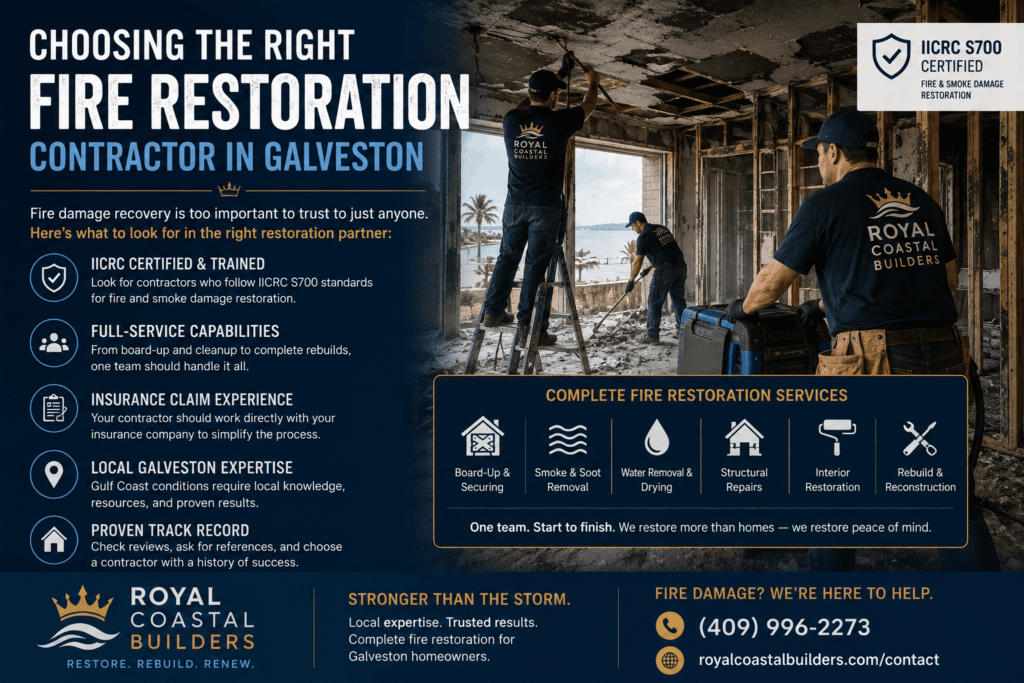
Fire restoration is one of the most technically demanding restoration disciplines, and in Galveston’s coastal environment it requires a contractor who combines fire restoration expertise with the building science knowledge that Gulf Coast conditions demand. The same factors that make post-storm and water damage contractor selection critical apply here — local presence, full-service capability, insurance claim experience, and verifiable Galveston market track record.
When evaluating fire restoration contractors in Galveston, ask whether the firm follows IICRC S700 standards for fire and smoke damage restoration — the professional framework that defines the cleaning methodologies, odor neutralization technologies, and documentation practices that a complete fire restoration requires.
Royal Coastal Builders provides emergency fire restoration services from initial board-up through complete structural rebuild — with the full-service trades capability to manage smoke remediation, structural assessment, electrical, plumbing, HVAC, roofing, and interior restoration under one team, and the insurance claim experience to support Galveston homeowners through every stage of the recovery process.
Fire restoration in Galveston is not a project where partial expertise is acceptable. The combination of fire damage chemistry, secondary water damage, Gulf Coast humidity, and the insurance claim process that governs the financial recovery all demand a team that understands every dimension of the problem — and has the local experience to manage it completely.
If your Galveston home has sustained fire damage, contact Royal Coastal Builders immediately at (409) 996-2273 or visit royalcoastalbuilders.com/contact to schedule an emergency assessment with our restoration team today.