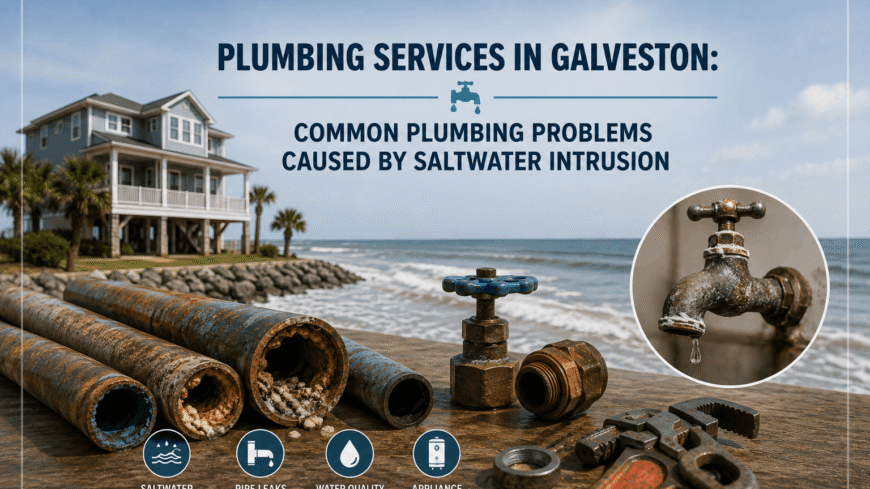
Plumbing services in Galveston address a category of problems that inland Texas plumbers rarely encounter: the systematic, chemistry-driven degradation that saltwater and salt air inflict on residential plumbing systems over time. On Galveston Island, the Gulf of Mexico and Galveston Bay do not simply create a beautiful backdrop for coastal living — they generate a corrosive environment that affects every metallic component in a home’s plumbing system, from supply lines and fixtures to water heaters and the connections between them.
Saltwater intrusion into Galveston plumbing systems is not a single event. It is a continuous process driven by the salt-laden air that permeates the coastal environment, by the mineral content of Galveston’s municipal water supply, and by the direct flood exposure that storm events bring to plumbing systems in one of the most hurricane-affected communities in the United States. Understanding how this process works — and which components are most vulnerable — is the foundation for the proactive maintenance and material decisions that protect Galveston homeowners from plumbing failures that are predictable, preventable, and expensive when they are not anticipated.
This guide covers the most common plumbing problems caused by saltwater intrusion in Galveston homes, the materials and systems that resist or accelerate those problems, and the maintenance practices that keep coastal plumbing systems performing reliably over the long term.
How Saltwater Damages Plumbing Systems — The Chemistry Behind the Problem
Before examining specific failure modes, it is useful to understand the fundamental chemistry that drives saltwater-related plumbing deterioration. Salt — sodium chloride — is one of the most effective electrolytes in nature, and electrolytes accelerate the electrochemical reactions that produce corrosion in metallic materials.
In a residential plumbing system, corrosion from saltwater exposure operates through several mechanisms:
- Galvanic corrosion occurs when two dissimilar metals are in contact in the presence of an electrolyte — salt water being an exceptionally effective one. The less noble metal corrodes preferentially and progressively. In a plumbing system where copper pipe connects to a galvanized steel fitting, or where a brass valve connects to a steel supply line, the electrochemical potential difference between the metals drives accelerated corrosion at the joint — often creating the pinhole leaks that are the most common plumbing failure mode in Galveston coastal homes.
- Pitting corrosion is a localized form of corrosion in which small pits form on the metal surface and deepen rapidly, eventually perforating the pipe wall. Chloride ions — the primary component of salt — are the most aggressive driver of pitting corrosion in copper and steel plumbing systems, and the chloride concentration in coastal air and water on Galveston Island is orders of magnitude higher than what inland plumbing systems experience.
- Crevice corrosion occurs in areas where salt water is trapped in a confined space — beneath a fitting, behind a washer, or in the threads of a connection — where oxygen depletion and chloride concentration combine to drive aggressive localized attack. Threaded connections and compression fittings are the most common sites for crevice corrosion in Galveston plumbing systems.
- Atmospheric corrosion from salt air affects all exposed metallic plumbing components — supply line fittings beneath sinks, hose bib connections, outdoor shower plumbing, and any metallic component in a space with ambient coastal air exposure. Salt particles carried on Galveston’s Gulf breezes deposit on surfaces, absorb atmospheric moisture, and create electrolyte films that drive corrosion even without direct water contact.
Understanding these mechanisms explains why the material choices, installation practices, and maintenance protocols that work reliably in inland Texas plumbing systems are not adequate for the coastal environment that Galveston homeowners live in.
Problem 1: Supply Line and Pipe Corrosion
The supply lines that connect fixture shutoff valves to faucets, toilets, and appliances are among the highest-failure plumbing components in Galveston homes. Standard braided stainless steel supply lines — the flexible connectors used under sinks, at toilets, and at appliance connections throughout most residential construction — use a stainless steel braid over a rubber or polymer inner tube, with brass end fittings that connect to shutoff valves and fixtures.
In a coastal salt air environment, the stainless steel braid on these supply lines corrodes from the outside in, even without direct water contact. The chloride in coastal air attacks the braid, creating surface rust that then penetrates into the weave, weakening the structural integrity of the braid that is the primary burst-resistance element of the supply line. Braided supply lines that appear intact on visual inspection can be significantly weakened by internal corrosion of the braid — creating burst failure risk that appears without warning.
For Galveston plumbing systems, the supply line specifications our plumbing team recommends over standard braided stainless include:
- Polymer-braided supply lines that replace the metal braid with a non-metallic reinforcement not subject to chloride corrosion
- Solid polymer supply lines in nylon or CPVC for applications where the supply line is in a particularly high-salt-air exposure location
- Inspecting and replacing all braided supply lines on a defined schedule — typically every five to seven years in high-exposure coastal locations — rather than waiting for visible failure
For rigid pipe systems within the wall, copper remains the most common residential supply pipe material in Galveston’s existing housing stock. Copper performs well in most conditions but is susceptible to pitting corrosion in the presence of high chloride content water — a risk that increases when the water passing through the system has elevated mineral content, which Galveston’s municipal supply exhibits at certain times of year. CPVC and PEX are increasingly specified in new coastal construction for their complete immunity to corrosion and their thermal performance advantages in Galveston’s hot climate.
Problem 2: Fixture and Fitting Failures
Plumbing fixtures and fittings in a Galveston home face salt air corrosion from outside as well as the mineral-laden water passing through them from inside. This dual attack accelerates the degradation of components that are designed primarily for single-direction water exposure in a non-corrosive atmosphere.
Common fixture and fitting failures in Galveston coastal plumbing systems include:
- Chrome-plated faucet and fixture failure. Standard chrome plating in a salt air environment shows pitting and corrosion within two to four years in high-exposure locations — outdoor shower areas, open-air porch sinks, and bathroom fixtures in spaces with limited ventilation. Once the chrome layer is breached, the base metal beneath corrodes rapidly. Specifying solid stainless, PVD-finished, or solid brass fixtures — as recommended in our guide to bathroom remodeling in Galveston — addresses the fixture corrosion problem at the specification level rather than accepting repeated replacement as the management strategy.
- Valve seat and washer deterioration. The rubber and neoprene components inside valves and faucets degrade in the presence of high mineral content water and in the elevated temperatures Galveston’s hot water systems generate. Valve seats corrode from the mineral content of the water passing over them; washers harden and lose their sealing capacity faster than in moderate-mineral inland systems. Dripping faucets in Galveston homes are often a mineral and corrosion problem at the valve seat as much as a mechanical wear problem.
- Threaded fitting leaks. Threaded connections between dissimilar metals — the galvanic corrosion scenario described above — are a persistent source of slow leaks at shutoff valves, hose bibs, and transition fittings between pipe materials. Dielectric unions at all dissimilar metal transitions, and the consistent use of appropriate thread sealants rated for the service conditions, are the installation practices that prevent these failures in new work and in repairs.
- Hose bib and outdoor fixture corrosion. Exterior plumbing components have no protection from direct salt air exposure. Galveston homes with outdoor showers, garden hose bibs, and irrigation connections see accelerated corrosion in these fixtures — which are often the last to be specified for coastal performance and the first to fail as a result.
Problem 3: Water Heater Degradation
The water heater is among the most salt air and mineral-content vulnerable major appliances in a Galveston home, and it is the one that creates the most significant secondary damage when it fails — typically through tank corrosion that leads to leakage into the surrounding space, with the mold and structural damage consequences that our mold remediation guide covers in detail.
The primary mechanism of water heater tank failure in coastal conditions is anode rod depletion. All tank-style water heaters contain a sacrificial anode rod — typically magnesium or aluminum — whose purpose is to corrode preferentially, protecting the steel tank lining from the corrosive mineral content of the water inside. In standard water conditions, an anode rod lasts four to six years before it is consumed to the point where it no longer provides adequate protection. In Galveston’s high-mineral-content water, anode rod depletion occurs significantly faster — often in two to three years — leaving the tank exposed to aggressive corrosion from within.
Most Galveston homeowners are unaware that anode rod inspection and replacement is a maintenance item at all, because most plumbing service providers do not include it in standard annual maintenance visits. By the time tank corrosion becomes apparent — through a rust-colored hot water supply, a sulfur odor, or visible leakage — the tank is typically past the point of repair.
Proactive water heater maintenance for Galveston coastal plumbing systems includes:
- Annual anode rod inspection and replacement when the rod is depleted beyond 50 percent of its original diameter
- Tank flushing to remove sediment accumulation from Galveston’s mineral-content water, which settles on the tank floor and creates accelerated corrosion at the sediment-tank interface
- Assessment of the pressure relief valve — a safety component that can corrode and fail to seat properly in high-mineral environments, creating both safety risk and slow leak conditions
- Consideration of tankless water heater systems — which eliminate the tank corrosion failure mode entirely by heating water on demand without storage. Tankless systems are not immune to scale buildup from high-mineral water, but they eliminate the tank failure risk and the significant water damage event that a corroded tank rupture produces
For Galveston vacation and beach homes where the water heater may sit idle for extended periods between visits, the stagnant water conditions in a tank-style heater during unoccupied periods accelerate bacterial growth and mineral deposition. Periodic flushing before extended unoccupied periods is a maintenance practice that significantly extends tank life and protects water quality.
Problem 4: Drain System Deterioration
While supply-side plumbing is primarily affected by the external salt air corrosion and internal mineral content mechanisms described above, drain systems in Galveston homes face their own deterioration challenges driven by the chemistry of what passes through them and the materials used in their construction.
- Cast iron drain pipe corrosion in older Galveston homes — particularly in the historic housing stock — presents as internal corrosion from the combination of sulfuric acid produced by bacterial activity on waste products and the chloride content of water from Galveston’s supply. Cast iron drain systems in Galveston homes built before 1970 are approaching or past their practical service life in many cases, and slow drainage, recurring blockages, and the occasional collapse of corroded pipe sections are the symptoms that precede full system failure.
- P-trap and drain fitting corrosion beneath sinks and fixtures — particularly in coastal bathrooms and kitchens where salt air exposure to the undersink cabinet space is regular — creates the drip leaks that go undetected for extended periods and produce the mold and cabinet damage that renovation contractors find when remodeling projects open these spaces.
- Root intrusion in older properties is compounded by the soil conditions of Galveston’s barrier island environment, where clay-heavy soils swell and contract with moisture cycling, placing lateral stress on buried drain lines that are not flexible enough to accommodate the movement.
PVC drain systems — the standard in all new residential construction — are immune to the corrosion mechanisms that affect cast iron, and their smooth interior surface resists the scale buildup that accelerates blockage formation in corroded cast iron. Where cast iron drain systems are deteriorating in a Galveston home, systematic replacement with PVC is the most reliable long-term solution.
Problem 5: Storm Surge and Flood Damage to Plumbing Systems
Galveston’s hurricane exposure creates a plumbing damage pathway that has no inland equivalent: the submersion of plumbing systems and appliances in Category 3 floodwater during storm surge events. As covered in our water damage restoration guide, plumbing components submerged in floodwater require professional assessment before the system is returned to service — not simply drying out and visual inspection.
Flood-specific plumbing failures in Galveston homes include:
- Pressure regulator displacement or failure from the hydraulic forces of storm surge water moving through and around the home’s supply system
- Water heater contamination — any tank-style water heater submerged in Category 3 floodwater must be replaced, as the interior cannot be effectively decontaminated and the electrical or gas components present safety risks after submersion
- Sewer line backflow contamination — storm surge and flooding events create pressure conditions in municipal sewer systems that can drive sewage backward through home drain systems, contaminating fixtures and drain components. Backflow prevention devices and proper P-trap maintenance are the defensive measures that reduce — though do not eliminate — this risk.
- Underground service line displacement from the soil movement that major flooding events produce beneath and around Galveston properties
Post-flood plumbing inspection by a licensed coastal plumber is a mandatory step in the restoration process for any Galveston home that has experienced significant water intrusion.
Proactive Plumbing Maintenance for Galveston Coastal Homes
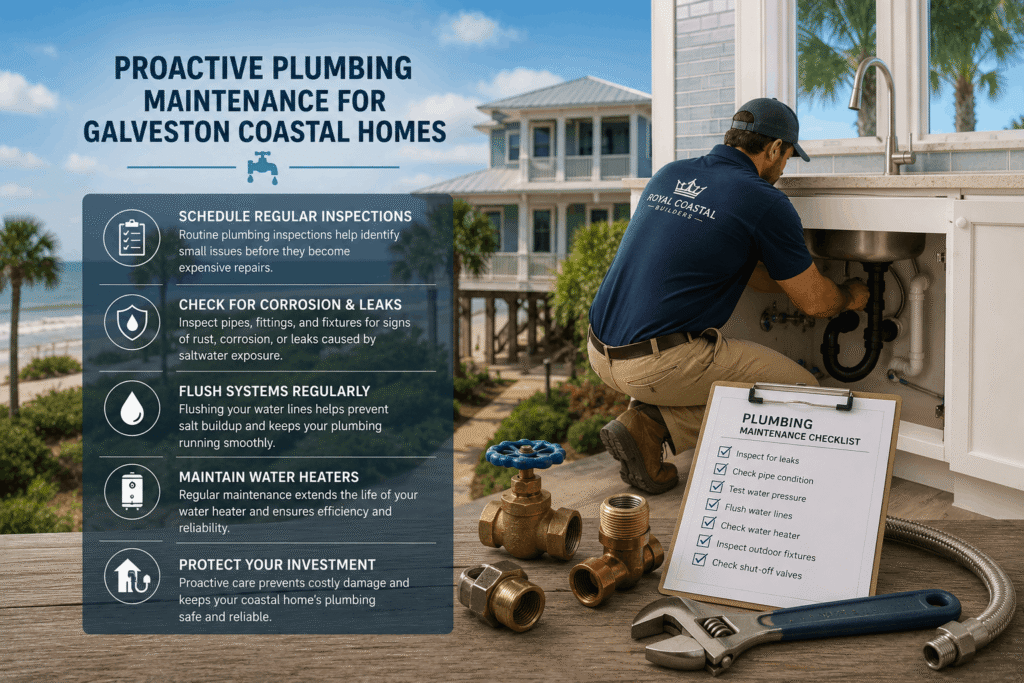
The common thread across every plumbing failure mode described above is predictability. Saltwater corrosion, anode rod depletion, cast iron drain deterioration, and supply line degradation all follow observable timelines and present identifiable precursors before catastrophic failure. The plumbing maintenance program that protects a Galveston home most effectively is one that inspects for these precursors on a defined schedule and addresses them before they escalate.
An annual coastal plumbing maintenance visit from Royal Coastal Builders’ plumbing team covers:
- Supply line inspection and condition assessment at all fixture connections
- Shutoff valve operation testing — valves that have not been operated in years can seize in the open position, eliminating the emergency shutoff capability they are meant to provide
- Water heater anode rod inspection and tank flush
- Under-sink and cabinet visual inspection for early corrosion and slow leak evidence
- Exterior fixture and hose bib condition assessment
- Drain flow and venting performance check
The Water Research Foundation has documented the accelerated infrastructure deterioration that high-mineral and high-chloride water conditions produce in residential plumbing systems — research that directly supports the more aggressive maintenance schedule that Galveston’s coastal water chemistry demands compared to inland standards.
For homeowners building new on Galveston Island, material specification decisions made during construction have the most lasting impact on plumbing system longevity. PEX supply piping, solid brass or PVD-finished fixtures, polymer-reinforced supply lines, and tankless water heaters represent the specification standard that our plumbing team recommends for all new coastal construction — addressing the saltwater intrusion problem at the material level before it has the opportunity to begin.
According to the American Society of Plumbing Engineers, coastal environments require material and installation standards that exceed the minimum code requirements designed for inland applications — a principle that Royal Coastal Builders applies to every plumbing project we undertake on Galveston Island.
Protecting Your Galveston Home’s Plumbing System for the Long Term
Saltwater intrusion is not a problem that Galveston homeowners can simply ignore and hope to avoid. The chemistry of coastal corrosion is patient, systematic, and indifferent to whether a plumbing system is new or decades old — it works on every metal component continuously. The homeowners who manage this problem most successfully are those who understand what is happening, specify the right materials when they build or renovate, and maintain their systems on a schedule calibrated to coastal conditions rather than inland norms.
Plumbing services in Galveston are most valuable not when they respond to failures that have already occurred — though Royal Coastal Builders is fully equipped for that as well — but when they prevent those failures through the combination of informed material selection, correct installation practice, and proactive annual maintenance.
Ready to protect your Galveston home’s plumbing system from saltwater damage? Contact Royal Coastal Builders at (409) 996-2273 or visit royalcoastalbuilders.com/contact to schedule a plumbing inspection or consultation today.