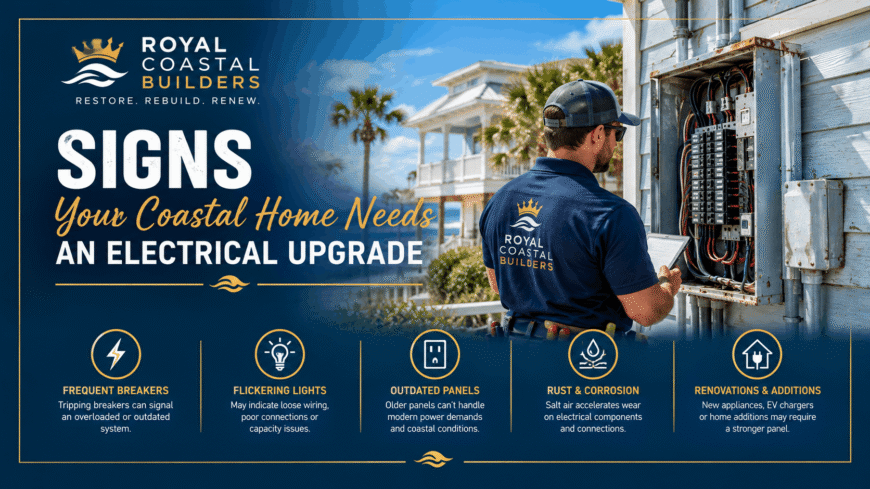
A residential electrician in Galveston fields a specific category of calls that inland electricians rarely receive: homeowners who noticed something wrong with their electrical system weeks or months ago, dismissed it as a minor inconvenience, and are now dealing with a tripped main breaker, a scorched outlet, or a failed circuit during a peak summer weekend with a house full of guests. The warning signs that a coastal home’s electrical system needs upgrading are rarely dramatic in their early stages — they present as flickering lights, slow-tripping breakers, and overloaded outlets that seem manageable until they are not.
In Galveston’s coastal environment, the timeline between early warning signs and genuine electrical hazard is compressed relative to what the same symptoms would predict in an inland home. Salt air corrosion accelerates the degradation of wiring insulation, connection integrity, and breaker performance. High ambient humidity creates conduction pathways in systems that were not designed for continuous moisture exposure. The heavy electrical loads that beach house living demands — multiple air conditioning systems, outdoor lighting, whole-house dehumidifiers, EV chargers, and the appliance surge of a fully occupied vacation home — stress electrical systems that were sized for the occupancy patterns of a different era.
This guide covers the most important warning signs that indicate a Galveston coastal home needs an electrical upgrade — and explains what each symptom reveals about the underlying condition of the system.
Why Coastal Homes Show Electrical Warning Signs Sooner
Before examining specific warning signs, it is worth understanding why Galveston coastal homes develop electrical system deficiencies faster than comparable homes in inland Texas markets. Three factors compound the normal aging process of a residential electrical system in the coastal environment:
Salt air accelerates insulation and connection degradation. Wiring insulation that maintains its dielectric properties for thirty years in a dry inland environment can become brittle, cracked, and compromised in fifteen to twenty years in Galveston’s persistent salt air humidity. Connection points — at outlets, switches, breaker terminals, and junction boxes — corrode under ongoing salt air exposure in ways that increase resistance, generate heat, and eventually create arc fault conditions. Our previous guide on protecting outdoor electrical panels from corrosion covers the chemistry of this process in detail.
Flood exposure creates hidden system damage. Galveston homes that have experienced flooding — from hurricane storm surge, bay flooding, or even significant interior water intrusion — carry electrical system damage that is often invisible to surface inspection but progressive in its consequences. Water-damaged wiring, corroded junction box connections, and flood-affected breaker contacts contribute to the warning signs described below, often appearing months or years after the flood event as corrosion progresses within concealed wiring runs.
Modern electrical loads far exceed what older coastal homes were designed for. A Galveston beach house built in the 1970s or 1980s was designed for the electrical load profile of that era — before whole-home air conditioning became standard in every room, before 240V EV chargers, before smart home systems, security cameras, whole-home audio, and the multiple large-screen televisions that define modern vacation home amenities. A 100-amp service that was adequate for 1980 occupancy patterns is genuinely undersized for the load a fully occupied modern beach house places on it.
Warning Sign 1: Frequently Tripping Breakers
A circuit breaker that trips occasionally — when a load exceeds its rated capacity — is performing exactly as designed. A breaker that trips repeatedly on the same circuit under normal use is telling you something different: either the circuit is chronically overloaded for the loads it now serves, or the breaker itself has degraded to the point where it trips at a lower threshold than its rating.
In Galveston’s coastal environment, both conditions are common:
- Chronically overloaded circuits develop in beach houses where kitchen circuits, bedroom circuits, and outdoor circuits are serving far more appliances and devices than they were originally designed for. A 15-amp kitchen circuit that originally served a 1970s kitchen with a toaster and a coffee maker is now serving an espresso machine, an air fryer, a convection microwave, and a wine refrigerator simultaneously.
- Degraded breakers that trip at sub-rated loads are a coastal corrosion consequence — the bimetal strip or magnetic trip mechanism within the breaker has been affected by salt air infiltration into the breaker body, causing it to trip at lower current levels than its rating specifies. A breaker that trips at 80 percent of its rated load is a breaker that needs replacement, and in a salt-air environment, this condition can develop across multiple breakers in a panel simultaneously.
Repeated breaker trips on the same circuit under normal loads warrant a professional assessment from a licensed residential electrician — not continued manual resetting that trains the homeowner to ignore a warning the system is actively generating.
Warning Sign 2: Flickering or Dimming Lights
Flickering lights are among the most commonly dismissed electrical warning signs in Galveston homes — attributed to power company fluctuations, loose bulbs, or “just how the house is” without investigation. While occasional minor dimming during compressor startup on a large AC unit is a normal characteristic of some electrical systems, persistent or worsening light flickering typically indicates one of several conditions that deserve professional assessment:
- Loose or corroded connections at the fixture, at the switch, or at the junction box or panel terminal serving that circuit. In Galveston’s salt air environment, connection corrosion is a primary driver of the increased resistance that produces voltage drop and the visible flickering it causes. A connection that flickers a light today is a connection that generates heat during normal operation — and heat at an electrical connection is the precursor to arc fault.
- Undersized wiring on circuits that have been loaded beyond their original design capacity. Wire sized for a 15-amp circuit running continuously at 80 percent of that capacity produces measurable voltage drop that manifests as dimming at lights on the same circuit.
- Failing breaker contacts creating intermittent resistance in the circuit supply. When the breaker contacts themselves are corroded or damaged, the circuit supply voltage fluctuates slightly with changes in current draw — producing the flickering that is most visible in incandescent or low-voltage lighting.
- Service entrance issues — loose or corroded connections at the utility meter base, the service entrance cable terminations, or the main breaker can cause whole-house dimming that is often most visible in lighting but affects all circuits simultaneously.
Persistent flickering in a Galveston coastal home should be treated as an investigation item rather than a tolerable quirk. The Electrical Safety Foundation International identifies loose or arcing connections as one of the leading causes of residential electrical fires — a risk that is amplified in a coastal environment where corrosion accelerates the degradation of connection integrity.
Warning Sign 3: Outlets That Are Warm, Discolored, or Sparking
Electrical outlets in a Galveston home should be cool to the touch, retain their original color without discoloration or scorch marks, and make a firm connection with plugged-in devices without sparking visible during insertion. Any departure from these baselines is a warning sign that warrants immediate attention:
- Warm or hot outlets indicate that the outlet’s internal connections or contacts are generating heat from elevated resistance — a direct indicator of corrosion at the connection points or of an outlet that has been cycled so many times its internal contacts have lost their spring tension and no longer make solid contact with plug prongs.
- Discoloration or scorch marks around an outlet indicate that arcing has already occurred at that location. An outlet with visible heat discoloration has experienced an arc fault event — the precursor to electrical fire — and must be replaced immediately regardless of whether it appears to be functioning normally at the time of discovery.
- Sparking on plug insertion — a brief small spark when plugging in a device under load is considered normal by some sources, but persistent sparking, large visible arcs, or sparking that produces a burning smell at the outlet indicate internal contact problems that require outlet replacement.
- Outlets that do not hold a plug firmly — outlets whose internal contacts have lost their clamping force create a loose connection between the outlet contacts and the plug prongs. This loose connection is exactly the condition that generates the resistance and heat at the connection point that drives arc fault development.
In older Galveston homes, outlets that show multiple warning signs concentrated in a specific area of the house often indicate localized wiring issues — a deteriorated wiring run, a junction box with compromised connections, or a circuit that has sustained moisture or flood exposure — rather than isolated individual outlet failures.
Warning Sign 4: Insufficient Outlets and Overreliance on Power Strips
A Galveston beach house built before 1990 typically has two or three outlets per room — a standard that reflected the appliance and device count of that era. A modern beach house bedroom has a phone charger, a tablet charger, a reading light, a sound machine, a ceiling fan with a remote receiver, a television, and potentially a window AC unit, all competing for those same two or three outlets. The result is a landscape of power strips, extension cords, and daisy-chained adapters that represent both a fire hazard and a signal that the electrical system has not kept pace with the demands placed on it.
Chronic power strip and extension cord use is not simply a tidiness problem — it is an electrical safety issue. Extension cords are rated for temporary use, not permanent load-bearing service. Power strips without surge protection and adequate amperage ratings can overheat under the loads that beach house occupancy regularly places on them. And in Galveston’s coastal environment, extension cords and power strips in garages, under-house storage areas, and outdoor spaces are subject to the same salt air and humidity degradation that affects fixed wiring — degrading faster than their ratings assume.
Adding dedicated circuits and additional outlets in the locations where load actually exists is the correct solution — work that requires a permit and a licensed residential electrician in Galveston who can route new circuits from the panel to the required locations with appropriate wire sizing and GFCI or AFCI protection where required by code.
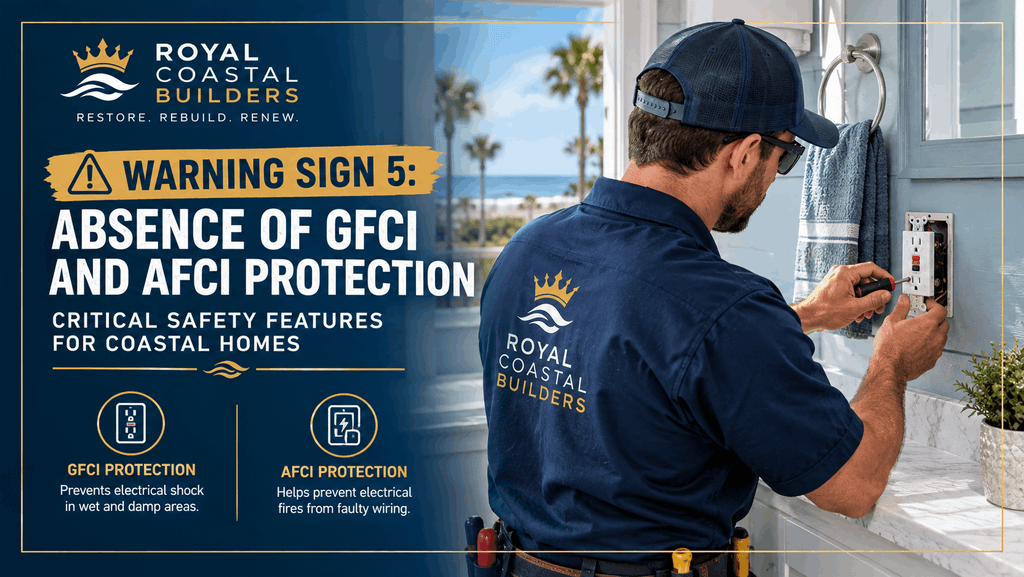
Warning Sign 5: Absence of GFCI and AFCI Protection
Two categories of protective circuit technology that are now required by the National Electrical Code in new construction and in renovation work were not present in residential electrical systems installed before the late 1970s and 1990s respectively. Their absence in an older Galveston home is not only a code compliance issue — it is a genuine safety deficiency that the coastal environment makes more consequential:
GFCI (Ground Fault Circuit Interrupter) protection is required in all bathroom, kitchen, garage, outdoor, and crawl space circuits in current code — anywhere that electrical outlets might be exposed to moisture contact. A GFCI device monitors current flow on the circuit and trips in fractions of a second when it detects a ground fault — the current diversion through a person’s body that produces electrocution. In Galveston’s humid coastal environment, where moisture contact with electrical systems is more frequent and less predictable than in a dry inland home, the absence of GFCI protection in wet locations is a genuine life safety issue, not a code technicality.
AFCI (Arc Fault Circuit Interrupter) protection is required in bedroom circuits and increasingly throughout the home in current code editions. AFCI breakers detect the specific current signatures produced by arc faults — the arcing at loose, corroded, or damaged connections that precedes electrical fire — and trip before the arc generates ignition temperatures. In a Galveston coastal home where connection corrosion is an ongoing condition, AFCI protection provides the active safety backstop that catches the arc fault events that corroded connections generate before they become fire events.
Homes without GFCI protection in wet locations and without AFCI protection in bedroom and living area circuits have electrical systems that do not meet current safety standards — regardless of whether the original installation met the code in effect at the time of construction.
Warning Sign 6: Aluminum Wiring in Post-1965 Homes
Between approximately 1965 and 1973, aluminum wiring was used extensively in residential construction in the United States as a lower-cost alternative to copper during a period of high copper prices. If your Galveston home was built during this period, it may contain aluminum branch circuit wiring — a condition that requires specific attention from a qualified residential electrician.
Aluminum wiring presents two challenges that are amplified in Galveston’s coastal environment:
- Oxide film formation at connections. Aluminum oxidizes more readily than copper, and the aluminum oxide film that forms at connection points has higher electrical resistance than the underlying metal. In Galveston’s salt air and humidity environment, this oxidation process is accelerated, increasing the rate at which connection resistance rises and the frequency of the overheating events that follow.
- Thermal expansion differential. Aluminum expands and contracts more than copper with temperature changes, causing connections to loosen over time through thermal cycling. Connections that loosen allow the oxide film to develop on the exposed metal surfaces, further increasing resistance — a self-reinforcing degradation cycle.
The U.S. Consumer Product Safety Commission has identified homes with aluminum branch circuit wiring as having a significantly higher risk of electrical fire than homes with copper wiring. The recognized remediation approaches are full rewiring with copper or the installation of CO/ALR-rated devices and wire nut connections at all outlets and switches — work that requires assessment and execution by a licensed residential electrician familiar with aluminum wiring remediation protocols.
Warning Sign 7: A 60-Amp or 100-Amp Service in a Modern Beach House
The service entrance — the point where utility power enters the home and feeds the main electrical panel — determines the total electrical capacity available to the entire home. Galveston beach houses built before 1980 commonly have 60-amp or 100-amp service entrance ratings. These service sizes, which were adequate for the electrical loads of their era, are genuinely insufficient for the modern beach house electrical load profile:
- A single 4-ton central air conditioning system draws 18 to 24 amps on a 240V circuit at startup
- A standard electric dryer draws 22 to 30 amps
- An EV charging station draws 24 to 40 amps at Level 2 charging
- A tankless electric water heater, as discussed in our guide to tankless water heaters for beach houses, draws 150 to 200 amps for a whole-house unit — making gas tankless a far more practical choice in homes without 200-amp service
A 60-amp or 100-amp service that is running at or near its capacity during peak beach house occupancy is a system that is being chronically stressed — running hot at the service entrance conductors and main breaker, shortening the life of every component in the system, and providing no headroom for the additional circuits that modern beach house amenities require.
Service entrance upgrade to 200 amps — the standard for new residential construction in Texas — is a permit-required scope that involves the utility company for the meter connection and a licensed electrician for the panel, service entrance conductors, and grounding system. Our electrical team coordinates the full scope of service upgrades, including utility notification and the permit and inspection process with the City of Galveston.
Warning Sign 8: Knob-and-Tube Wiring in Historic Galveston Homes
Historic Galveston homes built before approximately 1940 may contain knob-and-tube wiring — the original residential wiring system that ran unsheathed conductors through ceramic knob insulators and ceramic tube insulators through framing members. Knob-and-tube is not inherently dangerous in its original, unmodified condition — but in Galveston’s coastal environment and in the context of a century of use, modification, and renovation, it presents specific concerns:
- Insulation degradation. The cloth or rubber insulation on knob-and-tube conductors has a practical service life of 50 to 70 years under favorable conditions. A century-old Galveston home with original knob-and-tube wiring has insulation that is at or past its end of useful life in most locations — particularly in attic spaces where thermal cycling and UV exposure through roof ventilation accelerate insulation brittleness.
- Incompatibility with modern grounding. Knob-and-tube systems are ungrounded — they have no equipment grounding conductor. Modern appliances and electronics depend on the grounding conductor for both safety and equipment protection. Using three-prong adapters or replacing outlets with three-prong devices without an actual grounding conductor is a safety workaround that does not address the underlying system deficiency.
- Previous modification. Many historic Galveston homes have had knob-and-tube circuits modified, extended, or tapped into over decades of renovation — often not by licensed electricians and not in ways that maintained the safety characteristics of the original installation. Modified knob-and-tube systems present greater safety risk than original unmodified systems.
As discussed in our historic home restoration guide, systems replacement in a historic Galveston structure requires both the electrical expertise to do the work correctly and the preservation sensitivity to minimize unnecessary disturbance of historic building fabric.
When Warning Signs Mean It Is Time to Call a Residential Electrician in Galveston
The warning signs covered in this guide exist on a spectrum from early indicators that merit scheduled professional assessment to conditions that require immediate attention. The following warrant calling a residential electrician in Galveston without delay:
- Any outlet, switch, or panel component with visible scorch marks or heat discoloration
- A burning smell anywhere in the home, even if intermittent
- Breakers that will not reset or that trip immediately after resetting
- Any sparking visible at outlets, switches, or the panel
- A main breaker that has become hot to the touch
The following merit scheduled professional assessment within the next inspection cycle:
- Persistent flickering lights that have not been explained by a previous inspection
- Multiple breakers that trip repeatedly on normal loads
- A home built before 1980 that has not had a licensed electrical inspection within the past five years
- Any home that has experienced significant flooding without a post-flood electrical system inspection
The National Fire Protection Association recommends that homeowners have their electrical systems inspected by a licensed electrician when a home is more than 40 years old, when the home has had major renovations, or when visible warning signs are present — criteria that apply to a large portion of Galveston’s existing housing stock.
Royal Coastal Builders’ electrical team performs comprehensive electrical system assessments for Galveston coastal homes — evaluating service entrance capacity, panel condition, wiring type and condition, outlet and switch condition, GFCI and AFCI protection status, and the specific coastal corrosion factors that accelerate electrical system aging on Galveston Island.
Residential electrical upgrades in Galveston are permit-required work. Every upgrade our team performs is permitted, inspected, and completed to the current National Electrical Code standards — giving homeowners the documentation and the insurance compliance they need along with a safer, more capable electrical system.
Ready to have your Galveston home’s electrical system professionally assessed? Contact Royal Coastal Builders at (409) 996-2273 or visit royalcoastalbuilders.com/contact to schedule an inspection with our residential electrician team in Galveston today.