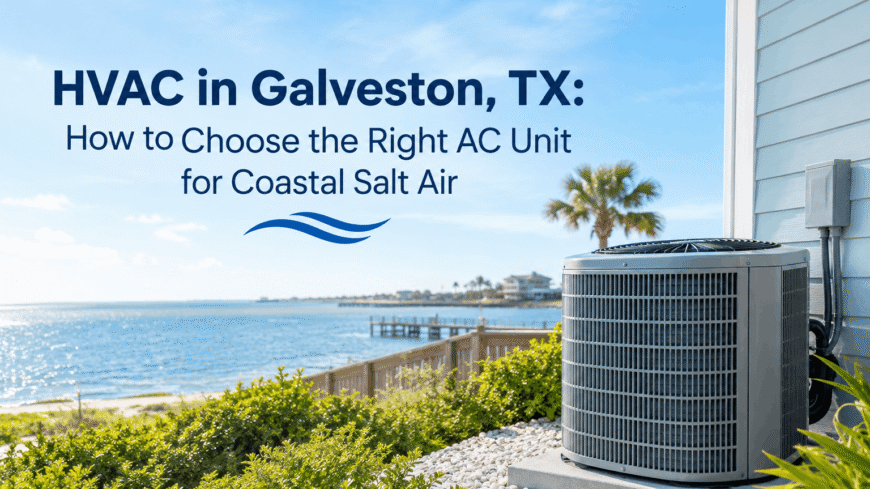
Choosing the right HVAC in Galveston, TX is one of the most consequential equipment decisions a coastal homeowner can make — and one that is routinely made with criteria designed for inland Texas rather than for the specific demands of a barrier island environment. The standard considerations that guide AC unit selection in Houston, San Antonio, or Dallas — SEER rating, equipment size, brand reputation, and upfront price — are necessary but not sufficient for a Galveston coastal home. On the Gulf Coast, the variable that determines whether an AC system delivers its expected service life or fails well before it is fully depreciated is almost always salt air resistance.
Galveston’s salt-laden marine air is among the most corrosive atmospheric environments that residential HVAC equipment encounters in the United States. The outdoor condenser unit — the large box-shaped component that sits outside the home and rejects heat to the outdoor air — contains aluminum fin coils, copper tubing, steel cabinets, and electrical components, all of which are subject to continuous salt air attack from the moment of installation. A standard residential condenser specified for an inland Texas climate and installed in Galveston without coastal-specific protections will begin showing corrosion damage within one to two years and can fail entirely before its warranty period expires.
This guide explains what actually matters when selecting an AC system for a Galveston coastal home — and what our HVAC team specifies to deliver the service life, comfort performance, and energy efficiency that Gulf Coast homeowners deserve.
Why Standard AC Units Fail Prematurely in Galveston’s Coastal Environment
To understand why coastal HVAC selection is different, it helps to understand what salt air actually does to a standard residential condenser unit over time.
The outdoor condenser coil — a dense array of aluminum fins wrapped around copper refrigerant tubing — is the primary heat exchange surface in any split-system air conditioner. It is also the component most vulnerable to salt air corrosion. Salt particles deposited on aluminum fin surfaces absorb atmospheric moisture and create an electrolyte film that drives the same galvanic and pitting corrosion mechanisms described in our guide to saltwater intrusion and plumbing systems in Galveston.
The corrosion sequence on an unprotected coastal condenser coil follows a predictable pattern:
- Salt deposits accumulate on the aluminum fin surfaces between maintenance intervals
- The deposited salt absorbs moisture from Galveston’s high-humidity air and creates an electrolyte layer
- Galvanic corrosion begins at the aluminum-to-copper contact points throughout the coil
- Aluminum fins begin to pit and degrade, reducing the effective surface area of the coil and impeding heat transfer
- As fin degradation advances, the system works harder to reject the same heat load, driving up energy consumption and compressor cycling frequency
- Refrigerant leaks develop as corrosion perforates the copper tubing within the coil assembly
- System failure occurs years before the projected equipment life
This sequence is not exceptional for Galveston coastal homes with unprotected standard condensers. It is the expected outcome. The question is not whether it will happen, but how many years of service life the homeowner gets before it does — and what the right specification choices at installation time can do to extend that timeline dramatically.
What to Look For: Key Specifications for Coastal AC Units
Condenser Coil Protection — The Most Important Specification
The single most important specification for a Galveston HVAC condenser is the coating or treatment applied to the outdoor coil. Not all manufacturers treat this the same way, and the difference in service life between a coated and an uncoated coil in a coastal salt air environment is measured in years.
The coil protection options available in the residential HVAC market, from least to most protective for coastal applications, are:
- No coating — standard aluminum fin coils: Appropriate for inland applications; should not be specified for direct coastal exposure in Galveston Island locations or within one to two miles of salt water
- Electrostatic epoxy or acrylic coatings: Factory-applied coatings that provide meaningful corrosion protection for moderate coastal exposure — appropriate for Galveston properties set back from direct salt air exposure
- Phenolic or polyurethane coatings: More chemically resistant than standard epoxy, these coatings provide good salt air protection and are appropriate for most Galveston residential locations
- Blue Fin or Gold Fin coatings: Proprietary factory-applied coatings used by major manufacturers for their coastal-rated product lines. These coatings provide the broadest protection for fin corrosion in marine environments and are the specification standard for direct coastal exposure locations on Galveston Island.
- Electrofin or field-applied epoxy coating: A field-applied coating option that can be applied to any condenser, creating a conformal coat over the entire coil assembly. This is the highest level of coil protection available and is appropriate for beachfront properties, elevated homes on the Gulf side, and any installation within 300 feet of open salt water.
For the majority of Galveston Island residential locations, specifying a manufacturer’s coastal-rated product line with Blue Fin or Gold Fin coil protection is the baseline recommendation. For beachfront and Gulf-front properties, supplementing with Electrofin field coating at installation provides the most complete protection available.
Stainless Steel or Coated Steel Cabinet Construction
The condenser cabinet — the steel housing that encloses the coil, compressor, and electrical components — is the second most vulnerable element to salt air corrosion after the coil itself. Standard galvanized steel cabinets develop surface rust in Galveston’s coastal environment within three to five years of installation, progressing to cabinet perforation and electrical component exposure as corrosion advances.
Coastal HVAC specifications should include:
- Stainless steel cabinet panels on equipment lines that offer them, providing corrosion resistance equivalent to what marine hardware applications use for salt water exposure
- Powder-coated steel cabinets with coastal-rated finishes as the minimum standard where stainless is not available
- Plastic or polymer louver guards over the coil intake areas rather than metal, eliminating a corrosion point at the most salt-air-exposed surface of the cabinet
Compressor Protection
The compressor is the heart of any split-system air conditioner — the component that is most expensive to replace and whose failure typically triggers full system replacement rather than repair. In a coastal HVAC specification, compressor protection against salt air intrusion is addressed through:
- Compressor blankets or covers that reduce direct salt air contact with the compressor shell and suction line
- Sealed electrical connections within the condenser cabinet, preventing salt air from reaching terminal blocks and relay contacts that corrode and create intermittent electrical failures
- Vibration isolation mounts rated for coastal exposure — standard rubber mounts deteriorate faster in UV-intense coastal environments
Central Split Systems Versus Ductless Mini-Splits for Coastal Galveston Homes
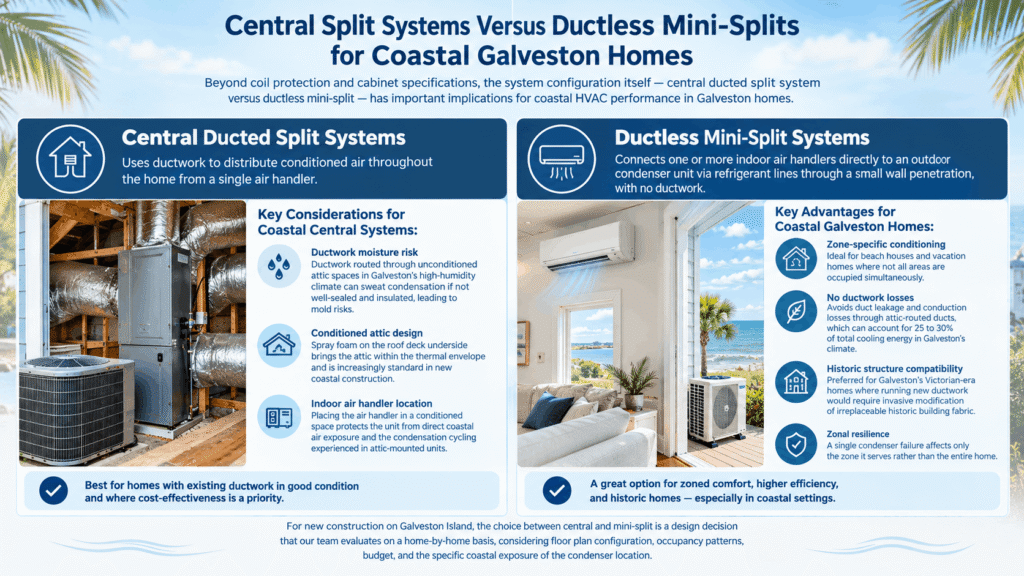
Beyond coil protection and cabinet specifications, the system configuration itself — central ducted split system versus ductless mini-split — has important implications for coastal HVAC performance in Galveston homes.
Central Ducted Split Systems
Central split systems use ductwork to distribute conditioned air throughout the home from a single air handler. For Galveston homes with existing ductwork in good condition, a central system is often the most cost-effective replacement path. Key considerations for coastal central systems:
- Ductwork routed through unconditioned attic spaces in Galveston’s climate is subject to high-humidity conditions that drive moisture problems throughout coastal homes. Ductwork that is not well-sealed and insulated can sweat condensation in humid coastal conditions, creating the moisture accumulation that our mold remediation guide addresses as a primary mold risk pathway.
- A conditioned attic design using spray foam on the roof deck underside brings the attic within the thermal envelope and is increasingly standard in new Galveston coastal construction.
- Air handler location within the conditioned space, rather than in an unconditioned attic, protects the unit from direct coastal air exposure and the condensation cycling that attic-mounted air handlers experience in humid coastal environments.
Ductless Mini-Split Systems
Ductless mini-split systems connect one or more indoor air handlers directly to an outdoor condenser unit via refrigerant lines through a small wall penetration, with no ductwork. They have distinct advantages for many Galveston applications:
- Zone-specific conditioning is well-suited to beach houses and vacation homes where not all areas are occupied simultaneously
- No ductwork losses — a significant efficiency advantage in Galveston’s climate, where duct leakage and conduction losses through attic-routed ducts can represent 25 to 30 percent of total cooling energy
- Compatibility with historic structures — as discussed in our historic home restoration guide, ductless mini-splits are the preferred cooling solution for Galveston’s Victorian-era homes where running new ductwork would require invasive modification of irreplaceable historic building fabric
- Zonal resilience — a single condenser failure affects only the zone it serves rather than the entire home
For new construction on Galveston Island, the choice between central and mini-split is a design decision that our team evaluates on a home-by-home basis, considering floor plan configuration, occupancy patterns, budget, and the specific coastal exposure of the condenser location.
SEER Ratings and Humidity Control in Galveston’s Climate
Seasonal Energy Efficiency Ratio (SEER) is the primary energy efficiency metric for residential air conditioning equipment, and in Galveston’s climate it tells an important but incomplete story about system performance. A high SEER rating measures cooling efficiency but does not directly measure dehumidification performance — which in Galveston’s persistently humid climate is as important as temperature reduction for occupant comfort.
As discussed in our energy-efficient coastal construction guide, the most common HVAC sizing error in coastal Texas homes is oversizing — installing equipment with more cooling capacity than the space requires. An oversized system reaches thermostat setpoint quickly and shuts off before running long enough to adequately remove moisture from the air. The result is a space that feels cool but humid — the clammy, uncomfortable condition that Galveston homeowners sometimes describe as their AC not working even when the temperature is correct.
For Galveston HVAC selection, the specifications that address both efficiency and humidity control are:
- Variable-speed or two-stage compressors — rather than the single-speed on-off operation of standard units, variable-speed systems modulate capacity to match the actual load, running longer at lower capacity during mild conditions and achieving significantly better dehumidification performance
- Proper Manual J sizing — our HVAC team sizes every system using Manual J load calculations that account for the specific thermal envelope, orientation, window area, and occupancy pattern of each home
- Dedicated whole-home dehumidification as a complement to the primary cooling system — particularly for Galveston vacation homes and beach houses where the AC may be set back during unoccupied periods but humidity must still be managed to prevent mold and material damage
- SEER2 ratings of 16 or higher for primary equipment, which in combination with proper sizing and variable-speed operation delivers meaningful energy cost reduction over the long Galveston cooling season
The Air Conditioning Contractors of America publishes the Manual J residential load calculation standard — the industry-recognized methodology that defines correct HVAC sizing for any climate, including coastal high-humidity environments like Galveston.
Condenser Placement — A Decision That Affects Performance and Longevity
Where the outdoor condenser unit is placed on a Galveston property significantly affects both its salt air exposure and its operational efficiency. This decision deserves deliberate consideration on a coastal property:
- Avoid placement on the Gulf-facing side of the home where direct ocean breeze exposure maximizes salt air deposition on the condenser coil. Locating the condenser on the leeward side of the structure — typically the north or northwest side — reduces direct salt air exposure meaningfully without affecting system performance.
- Maintain adequate clearance from vegetation and fencing that can restrict airflow through the condenser coil, reducing heat rejection efficiency and increasing operating pressures.
- Elevate condensers above the base flood elevation where practical — a condenser submerged in floodwater during a storm event requires replacement, as discussed in the water damage restoration guide. Elevated condenser pads or wall-mounted brackets position the unit above typical surge levels for many Galveston properties.
- Shade exposure consideration — a condenser operating in direct afternoon western sun in Galveston’s summer heat runs at higher head pressure than one in shade, reducing efficiency and increasing compressor stress.
Coastal HVAC Maintenance — What the Galveston Schedule Requires
Even the best-specified coastal HVAC system requires a maintenance schedule calibrated to the salt air environment rather than the standard once-a-year service visit that inland Texas systems receive. The maintenance practices that extend condenser life in Galveston’s coastal conditions include:
- Quarterly coil rinsing with fresh water to remove salt deposits before they have time to drive corrosion — the most impactful single maintenance action available for coastal condenser longevity
- Annual comprehensive maintenance including coil cleaning, electrical connection inspection and tightening, refrigerant charge verification, capacitor and contactor inspection, and drain pan and condensate line clearing
- Biannual inspection of coil coating condition — coatings do not last indefinitely, and identifying areas where coating has worn through allows spot reapplication before the exposed fin surfaces begin to corrode
- Filter replacement on a coastal schedule — in Galveston’s salt-particle-laden coastal air, air handler filter loading occurs faster than in clean inland air. Monthly filter checks during the cooling season are appropriate for most Galveston residential applications.
- Post-storm inspection following any significant weather event — condensers subjected to storm surge, windblown debris impact, or extended operation during storm conditions should be professionally inspected before being returned to routine service
Royal Coastal Builders’ HVAC team offers coastal-specific maintenance programs for Galveston homeowners — including the quarterly coil rinsing and annual comprehensive service that protect coastal equipment investments over the full system life.
Making the Right HVAC Investment for Your Galveston Home
The right AC unit for a Galveston home is not the standard residential option from a big-box supplier installed by a general HVAC contractor who works primarily inland. It is a system specified with coastal coil protection, appropriate cabinet construction, correct sizing for the humidity demands of the Gulf Coast climate, and a maintenance program calibrated to the salt air environment it operates in.
HVAC in Galveston, TX demands this level of specificity because the equipment cost of getting it wrong — premature condenser failure, refrigerant loss, compressor replacement, and the full system replacement that follows — far exceeds the modest premium that coastal-appropriate specification adds at installation.
Royal Coastal Builders’ HVAC team has been specifying, installing, and maintaining AC systems in Galveston’s coastal environment for years — with the product knowledge, coastal maintenance protocols, and whole-home building science perspective that makes the difference between a system that performs for fifteen years and one that needs replacement in five.
Ready to choose the right HVAC system for your Galveston home? Contact Royal Coastal Builders at (409) 996-2273 or visit royalcoastalbuilders.com/contact to schedule an HVAC consultation with our coastal team today.