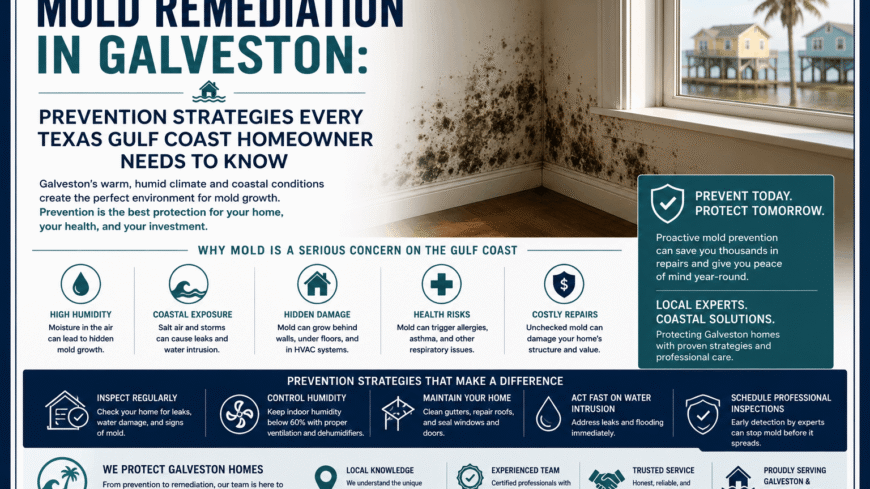
Mold remediation in Galveston is a service that no homeowner wants to need — and one that the right prevention strategies can help you avoid entirely. On the Texas Gulf Coast, mold is not an occasional nuisance. It is a persistent structural and health threat driven by the same conditions that make Galveston Island one of the most beautiful places to own a home: warm temperatures, abundant moisture, and a climate that rarely gives mold the cold or dry periods that would naturally inhibit its growth.
Galveston’s ambient relative humidity regularly exceeds 70 to 80 percent during summer months, and coastal homes experience moisture pressure from multiple directions simultaneously — humidity in the outdoor air, salt air moisture migrating through building assemblies, condensation on cool surfaces within the home, and the ever-present risk of water intrusion from storms. In this environment, mold does not simply appear after a flood event. It grows wherever moisture and organic material meet — in wall cavities, beneath flooring, inside HVAC ductwork, behind cabinetry, and in attic assemblies — often without any visible indication until the colonization is already significant.
Understanding how mold establishes itself in Gulf Coast homes, and building the right prevention strategies into the structure and systems of your home, is the most cost-effective approach to mold management available to Galveston homeowners. This guide covers both — with the construction and systems-level depth that separates genuine mold prevention from surface-level advice.
Why Galveston Homes Are Uniquely Vulnerable to Mold
Before addressing prevention, it is important to understand what makes mold risk so elevated in Galveston specifically — because the conditions on the Texas Gulf Coast amplify every factor that supports mold growth simultaneously.
Mold requires four things to establish and spread: moisture, organic material to feed on, warmth, and time. Galveston homes provide all four in abundance:
- Moisture is omnipresent in coastal air, in the ground beneath elevated foundations, in the building materials themselves as they absorb humidity over years of exposure, and in the regular storm events and flooding that affect the island
- Organic material exists throughout every conventional home — wood framing, cellulose insulation, drywall paper facing, OSB roof decking, engineered wood subfloor, and the contents of the home itself
- Warmth is effectively year-round on the Gulf Coast — Galveston’s mild winters rarely produce the sustained cold that would suppress mold activity for extended periods
- Time is the variable that prevention strategies are designed to eliminate — when moisture is controlled continuously, mold never gets the sustained wet period it needs to colonize
The EPA recommends maintaining indoor relative humidity below 60 percent — and ideally between 30 and 50 percent — to inhibit mold growth. Achieving that target consistently in a Galveston home without the right building systems and construction details is genuinely difficult, which is why passive prevention strategies built into the home’s construction are so much more reliable than reactive moisture management.
Strategy 1: Start with the Building Envelope — Stop Moisture Before It Enters
The most effective mold prevention strategy available in new construction or a major renovation is a building envelope that is designed and detailed to prevent moisture from entering the building assembly in the first place. Mold that never gets a moisture source never grows — and a well-executed building envelope addresses moisture intrusion at every potential entry point.
Key building envelope strategies for Gulf Coast mold prevention include:
Continuous Air and Vapor Barriers
Standard fiberglass batt insulation in wall cavities provides no resistance to moisture-laden air movement. In Galveston’s hot, humid climate, warm humid outdoor air migrates inward through wall assemblies, hits the cooler interior surface of the drywall, and condenses — creating persistent moisture within the wall cavity that is invisible from either side and provides ideal mold conditions.
Closed-cell spray foam insulation addresses this mechanism directly. By filling the wall cavity completely and creating an air-impermeable layer, it prevents humid air from circulating through the assembly and eliminates the condensation surface. This is why our energy-efficient coastal construction guidance consistently specifies closed-cell spray foam over standard batt insulation for Gulf Coast applications.
For walls where spray foam is not used, a continuous exterior air barrier membrane installed behind the cladding intercepts moisture-laden air before it can enter the wall assembly — a code-minimum requirement in many coastal jurisdictions that deserves specification significantly beyond the minimum.
Proper Flashing and Sealants at All Penetrations
Every penetration through the building envelope — windows, doors, electrical conduits, plumbing penetrations, HVAC connections — is a potential moisture entry point if not properly flashed and sealed with products rated for coastal UV and humidity exposure. Standard residential flashing tapes and sealants degrade in Galveston’s high-UV, high-humidity environment significantly faster than their manufacturers’ ratings suggest for inland applications.
Specifying coastal-grade flashing products and marine-rated sealants at all envelope penetrations is a detail that adds modest material cost but dramatically reduces the lifetime moisture intrusion risk — and the mold remediation expense that follows.
Roof Assembly Design
The roof is the largest and most exposed surface on a Galveston home. A compromised roof assembly — whether from storm damage, fastener failure, or degraded sealing over time — creates the most significant moisture entry pathway available to a coastal home. As discussed in our guide to mold prevention after storm events, even minor roof penetrations in Galveston’s high-humidity environment can generate significant wall and ceiling mold colonization before the leak is visually apparent.
A conditioned attic design — using closed-cell spray foam applied directly to the underside of the roof deck rather than on the attic floor — eliminates the vented attic space where humid coastal air circulates freely and dramatically reduces the moisture load on the entire roof assembly.
Strategy 2: HVAC Design and Operation as a Mold Prevention System
The HVAC system is the primary active moisture management tool in any Galveston home, and how it is designed, sized, and operated has a direct and substantial impact on indoor mold risk. Many Galveston homes with mold problems have HVAC systems that are functioning exactly as designed — the design is simply wrong for the coastal application.
The Oversizing Problem
The most common HVAC error in coastal Texas homes is oversizing. A system that is too large for the space it serves cycles on and off too rapidly to adequately dehumidify the air it is conditioning. In Galveston’s climate, humidity removal is as important as temperature reduction for preventing mold-supporting moisture conditions. An oversized system that keeps the air cool without removing sufficient humidity creates precisely the conditions — warm enough for mold, moist enough for mold — that drive colonization.
Our HVAC team sizes every system using Manual J load calculations that account for the specific thermal characteristics of each home and the dehumidification requirements of the coastal climate — not rules of thumb that routinely produce oversized equipment.
Dehumidification Systems
In Galveston’s climate, a whole-home dehumidification system operating in parallel with the primary HVAC is one of the most effective mold prevention investments available. A dedicated dehumidifier maintains indoor relative humidity within the target 45 to 55 percent range even during mild weather periods when the air conditioning is not running frequently enough to remove sufficient moisture through the cooling process alone.
This is particularly important in Galveston beach homes and vacation properties that may sit unoccupied for periods between visits — times when the HVAC may be set back to an economy temperature but is not running frequently enough to manage coastal humidity in an unoccupied home.
Ductwork Inspection and Maintenance
HVAC ductwork in an unconditioned attic space is a mold vulnerability point in coastal homes. Ducts that are improperly sealed or insulated sweat condensation in humid coastal conditions, creating moisture inside the duct system that supports mold growth and distributes spores through the home’s air supply with every cycle. Annual ductwork inspection and sealing is a routine maintenance item that prevents a significant but largely invisible mold risk pathway.
Strategy 3: Bathroom and Kitchen Ventilation Engineered for Coastal Humidity
Bathrooms and kitchens generate more localized moisture than any other area of a residential home, and in a Galveston coastal environment where ambient humidity is already elevated, inadequate ventilation in these spaces creates near-constant mold-conducive conditions on surfaces, in grout joints, behind cabinetry, and inside wall assemblies adjacent to wet zones.
Our bathroom remodeling guidance specifies humidity-sensing exhaust fans rated at a minimum of 1 CFM per square foot of bathroom area — with automatic operation that removes the reliance on occupant behavior that standard manual-switch fans require. In a vacation or rental property where guests may not consistently use ventilation fans, automatic humidity-sensing operation is particularly important.
For kitchen ventilation, ducted range hoods exhausted directly to the exterior — not recirculating systems — are essential in coastal kitchens where cooking moisture compounds the already elevated ambient humidity. Properly sized ducted kitchen ventilation removes both moisture and airborne grease particles that can support mold growth on surfaces where they settle.
Exhaust fan ductwork in both bathrooms and kitchens must be routed to the exterior with properly installed coastal-rated termination caps — not terminated into attic spaces, which is a common installation shortcut that simply moves kitchen and bathroom moisture into the attic assembly, creating a mold risk in a less visible location.
Strategy 4: Plumbing System Maintenance and Leak Detection
Slow plumbing leaks are one of the most common sources of concealed mold growth in Galveston homes. A pinhole leak in a supply line inside a wall cavity, a degraded wax ring beneath a toilet, or a slow drain connection failure beneath a sink can introduce moisture continuously into wall assemblies and subfloor systems for months before any visible sign appears — and in that time, establish a significant mold colony that requires professional remediation to address.
Proactive plumbing maintenance strategies for Gulf Coast mold prevention include:
- Annual inspection of all visible supply line connections, particularly at the flexible braided lines beneath sinks and at toilet supply connections, where failures are most common
- Drain line inspection at all fixture P-traps and at accessible drain connections, where root intrusion and joint failures can create slow leak conditions
- Water heater assessment for tank integrity and anode rod condition — a failing water heater tank can leak slowly into the surrounding space for an extended period before rupturing completely
- Smart leak detection devices at high-risk locations — beneath sinks, near the water heater, and at washing machine connections — that provide immediate alerts to moisture presence before significant damage accumulates
Our plumbing team performs comprehensive plumbing inspections as part of both remodeling projects and standalone maintenance assessments, identifying the slow-leak vulnerabilities that most homeowners discover only after mold is already established.
Strategy 5: Crawl Space and Foundation Moisture Management
For Galveston homes with enclosed under-floor spaces — whether a traditional crawl space or an enclosed area beneath an elevated structure — moisture management in that zone is a critical mold prevention factor that is frequently overlooked. The soil beneath a coastal Texas home releases moisture vapor continuously, and without proper vapor management, that moisture migrates upward into the floor assembly and the living space above.
Effective foundation moisture management strategies include:
- Continuous ground-cover vapor barriers in enclosed under-floor spaces, using heavy-gauge polyethylene installed continuously across the soil surface and sealed at penetrations and foundation walls
- Adequate ventilation or full encapsulation of the under-floor space — conventional vented crawl spaces can actually introduce more coastal humidity than they remove in Galveston’s climate, making full encapsulation with a conditioned or dehumidified under-floor space a more reliable option
- Grading and drainage management at the foundation perimeter to direct surface water away from the structure rather than allowing it to pond against the foundation and percolate into the soil immediately beneath the home
For elevated homes built on pilings — the most common new construction format in Galveston’s flood zones — the open under-floor area reduces direct soil moisture transfer but introduces different moisture pathways through wind-driven rain exposure to the underside of the floor assembly. Proper insulation and air barrier detailing on the underside of the floor is the relevant prevention measure for these structures.
When Prevention Fails: Recognizing Early Mold Indicators
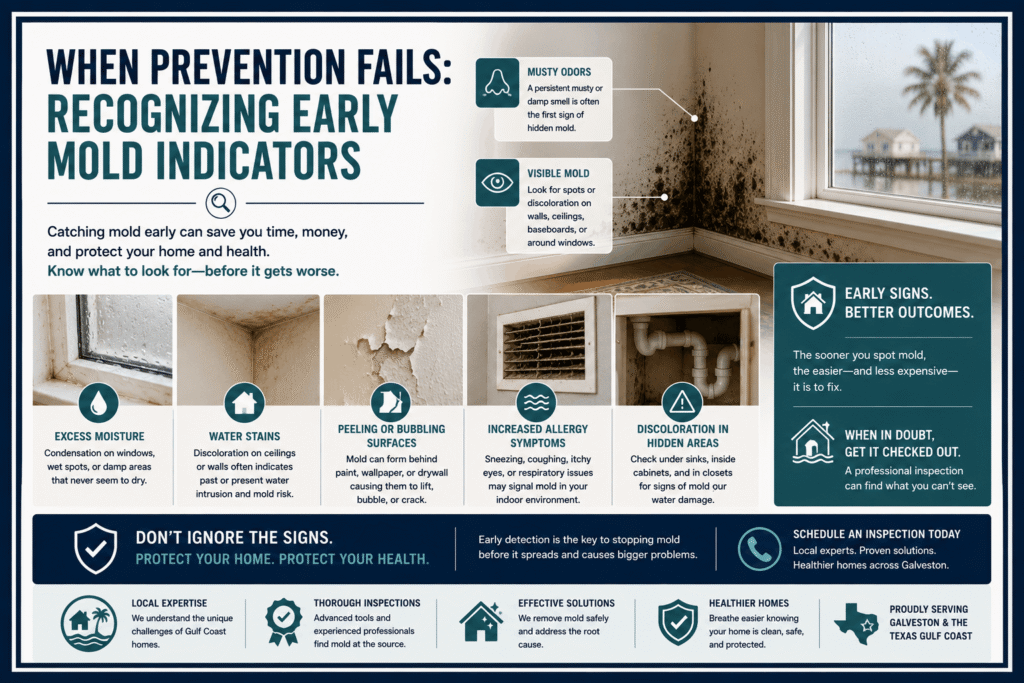
Even the most carefully maintained Galveston home can develop mold conditions following an unexpected leak, a storm event, or the gradual failure of a building system component. Recognizing the early indicators of mold presence allows for intervention before colonization becomes extensive:
- Persistent musty odor in any area of the home — mold produces volatile organic compounds that create a distinctive smell before visible growth is apparent
- Visible discoloration on drywall, ceilings, grout lines, or wood surfaces — ranging from gray to green to black depending on species
- Unexplained respiratory symptoms among occupants — particularly in specific areas of the home — that do not correlate with other health factors
- Peeling or bubbling paint on interior wall surfaces, indicating moisture migration through the wall assembly from behind
- Soft or spongy floor areas adjacent to plumbing fixtures, suggesting subfloor moisture saturation
When any of these signs appear, early professional assessment is significantly less expensive than waiting for the condition to develop. Royal Coastal Builders’ emergency services team provides mold assessment and remediation as part of our full-service coastal construction and restoration capability — with the building science background to identify moisture sources, not just visible mold symptoms.
According to the EPA’s mold guidance for homeowners, mold should generally not be left for extended periods without professional assessment when the affected area exceeds 10 square feet — a threshold that is often exceeded by the time visible mold is first detected in a wall cavity or attic space.
Professional Mold Remediation: What the Process Involves
When prevention has not been sufficient and mold remediation in Galveston is necessary, understanding what a professional remediation process involves helps homeowners evaluate contractors and set realistic expectations for the scope and timeline of the work.
A complete professional mold remediation process in a Gulf Coast home typically includes:
- Moisture source identification and correction — remediation without addressing the source is temporary. The moisture condition that allowed mold to establish must be corrected before any remediation work begins.
- Containment of the affected area using physical barriers and negative air pressure systems that prevent spore dispersal to unaffected areas of the home during remediation
- Removal of contaminated materials that cannot be effectively cleaned — drywall, insulation, carpet, and some structural elements may require removal and replacement rather than surface treatment
- HEPA vacuuming and antimicrobial treatment of exposed structural surfaces following material removal, eliminating residual spore populations before enclosure
- Post-remediation air quality testing by a third-party industrial hygienist to verify that spore counts have returned to background levels before the area is enclosed and finished
- Root cause correction — repairing the building system failure, plumbing leak, or envelope penetration that introduced the moisture in the first place, confirmed before the remediation area is closed
The CDC’s guidance on mold and health provides authoritative information on health risks associated with mold exposure and the standards that professional remediation should meet — a useful reference for homeowners evaluating remediation contractors and verifying that proposed scopes of work are complete.
Building a Mold-Resistant Gulf Coast Home From the Ground Up
The most cost-effective mold strategy for any Galveston homeowner is building or renovating with mold prevention as a design priority from the start. Closed-cell spray foam in walls and roofs, properly sized and configured HVAC with dedicated dehumidification, humidity-sensing bathroom ventilation, coastal-grade plumbing specifications, and a building envelope detailed for moisture management at every penetration — these are the investments that prevent mold remediation costs rather than simply responding to them.
Mold remediation in Galveston will always be a service that Gulf Coast homeowners need when prevention systems fail or were never in place. But for homeowners who build or renovate with the right guidance, the frequency and scale of those events can be dramatically reduced.
Ready to build or renovate a Galveston home that is designed to resist mold from the foundation up? Contact Royal Coastal Builders at (409) 996-2273 or visit royalcoastalbuilders.com/contact to speak with our coastal construction team today.