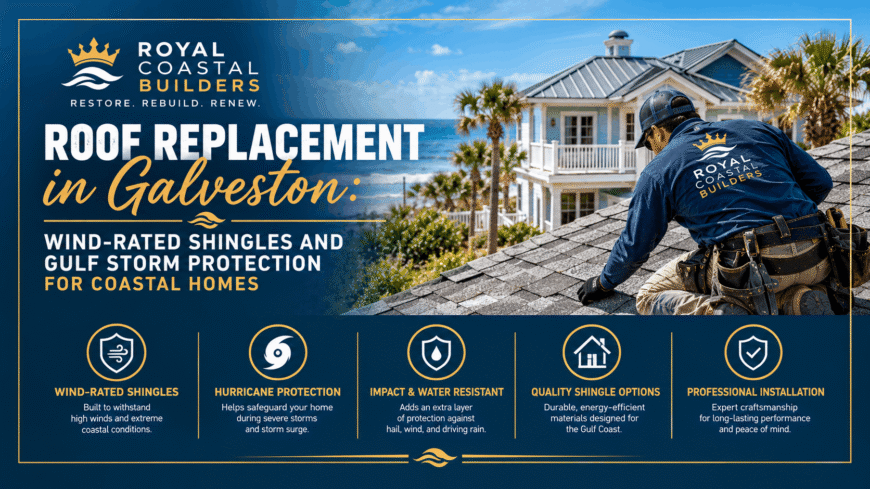
Roof replacement in Galveston is not simply a material swap — it is a critical structural decision that determines how your home performs under the wind speeds, wind-driven rain, and pressure differentials that Gulf Coast storms deliver. When a Galveston homeowner replaces a roof without understanding the wind rating systems that govern coastal roofing performance, the result is frequently a new-looking roof that fails in the first significant tropical weather event — sending shingles across the neighborhood and exposing the roof deck to the catastrophic water intrusion that follows.
Galveston Island sits in one of the most hurricane-exposed corridors in the United States. The Texas Coastal region experiences direct hurricane landfalls and near-miss tropical storm events with a frequency that makes wind performance the defining selection criterion for any roofing material or system installed here. A shingle that performs acceptably in central Texas — surviving the occasional spring hailstorm and summer thunderstorm — faces fundamentally different demands on Galveston Island, where sustained hurricane winds exceed 130 miles per hour in major storm events and where every roof is evaluated not just by how it looks after installation but by how it holds together when a Category 3 makes landfall fifty miles to the west.
This guide covers the wind rating systems that govern shingle performance, the installation standards that make the difference between a rated shingle and a roof that actually performs to that rating, the TWIA compliance requirements specific to Galveston, and the replacement decision framework that Galveston homeowners need when evaluating a failing roof or planning a proactive upgrade.
Understanding Wind Rating Systems for Asphalt Shingles
The wind resistance of an asphalt shingle is not a single number or a manufacturer’s claim — it is a measurement produced by standardized testing under specific conditions, and the differences between rating levels have real-world consequences in a Gulf Coast storm environment. Two primary testing standards govern wind rating for asphalt shingles:
UL 2390 — The Industry Standard for Wind Resistance
UL 2390 (formerly ASTM D7158) is the current primary standard for asphalt shingle wind resistance testing. It measures the wind speed at which a shingle fails the test — defined as the shingle lifting, cracking, or detaching from the test deck under simulated wind loading. UL 2390 classifies shingles into three performance classes:
- Class D — rated for wind speeds up to 90 miles per hour. Appropriate for moderate wind exposure locations; not adequate for Galveston’s hurricane zone exposure.
- Class F — rated for wind speeds up to 110 miles per hour. A meaningful improvement over Class D but still below the sustained wind speeds associated with Category 2 and stronger hurricanes that affect Galveston Island.
- Class H — rated for wind speeds up to 150 miles per hour. The minimum appropriate wind rating for roof replacement in Galveston’s coastal hurricane zone. Class H shingles use enhanced adhesive strips, reinforced mat construction, and thicker sealant lines that together resist the uplift forces generated by major hurricane wind speeds.
ASTM D3161 — The Legacy Standard
ASTM D3161 is an older standard still referenced on many shingle products. It uses a fan-test methodology that subjects shingles to sustained wind speeds in a testing chamber. ASTM D3161 classifications are:
- Class A — rated for 60 mph wind resistance
- Class D — rated for 90 mph wind resistance
- Class F — rated for 110 mph wind resistance
For roof replacement in Galveston, shingles meeting ASTM D3161 Class F or UL 2390 Class H represent the appropriate performance threshold. Many premium shingle lines from major manufacturers carry both ratings — look for explicit labeling on the product documentation rather than relying on general marketing descriptions of “wind resistance.”
Miami-Dade Notice of Acceptance (NOA)
The Miami-Dade County product approval system — the Notice of Acceptance — is the most rigorous wind resistance certification available for building products in the United States, developed in response to the catastrophic roof failures observed after Hurricane Andrew in 1992. Products carrying Miami-Dade NOA approval have been tested to withstand the extreme wind pressures of a major hurricane and meet the most stringent building code requirements in the country.
For Galveston homeowners who want the highest available assurance of shingle performance in a major hurricane, specifying a shingle product with Miami-Dade NOA approval provides that assurance — and may also qualify the home for preferred treatment under Texas Windstorm Insurance Association (TWIA) underwriting.
Why Rating Alone Is Not Enough — Installation Is Half the Performance Equation
One of the most consequential misunderstandings in the roofing market is the assumption that purchasing a wind-rated shingle guarantees wind-rated roof performance. It does not. A Class H shingle installed incorrectly performs no better in a hurricane than a Class D shingle installed correctly — and in some failure modes, worse, because the added weight of a heavier shingle creates greater peel forces on fasteners that were not properly placed.
The installation variables that determine whether a wind-rated shingle actually delivers its rated performance in a Gulf Coast storm include:
Fastener Placement and Count
Asphalt shingles are fastened to the roof deck with roofing nails, and the number of nails per shingle and their placement within the shingle’s nail zone are critical to wind performance. Most standard installations use four nails per shingle, placed within the nail zone specified by the manufacturer. For high-wind applications in Galveston’s coastal zone, six nails per shingle — the enhanced fastening pattern allowed by most major manufacturers’ wind warranties — provides measurably better resistance to wind uplift at the shingle tabs and edges where wind peeling initiates.
Nail placement outside the manufacturer’s specified nail zone — a common installation error — bypasses the shingle’s sealant strip entirely, creating a fastening that holds the shingle to the deck but does not engage the adhesive bond between shingles that is the primary mechanism of tab wind resistance. A roof full of misplaced nails will lose tabs in the first strong wind event regardless of what Class H label the shingles carry.
Starter Strip Installation
The starter strip — the first row of material installed at the eave and rake edges of the roof — is the most vulnerable wind zone on any shingle roof. Wind uplift initiates at the roof edges, and a starter strip that is correctly installed with sealant facing up and positioned to seal the leading edge of the first shingle course provides the critical adhesive bond that prevents edge peeling from propagating up the roof. A starter strip incorrectly positioned, or replaced by flipped regular shingles as a cost-cutting measure, eliminates this protection entirely.
For Galveston roof replacements, our roofing team specifies and installs purpose-made starter strip products with pre-applied sealant rather than field-cut alternatives — a detail that costs very little but contributes meaningfully to the roof’s wind edge performance.
Underlayment Specification
The underlayment installed beneath the shingles is the roof’s secondary water barrier — the layer that protects the roof deck and structure from water intrusion if the primary shingle layer is compromised by wind. In a Gulf Coast storm event, this secondary barrier is not a theoretical backup — it is the actual line of defense during and immediately after a major hurricane when shingle damage is likely and emergency tarping has not yet been deployed.
Standard 15-pound felt underlayment — the minimum code-compliant option in many jurisdictions — tears in high-wind conditions and provides minimal water resistance when exposed. For Galveston roof replacements, the underlayment options that provide genuine secondary protection are:
- Synthetic underlayment — polymer-reinforced products that are significantly more resistant to wind tear and water penetration than felt, and that maintain their weather-resistance properties longer when exposed during construction or in the days following a storm event
- Self-adhering modified bitumen membrane (peel-and-stick) — applied directly to the roof deck without fasteners, creating a fully adhered waterproof layer that provides water intrusion protection even when heavily damaged shingles expose it for extended periods. Self-adhering underlayment is the standard specification for high-wind zones in the most demanding coastal markets and is required by some insurance carriers for premium discounts in hurricane-exposed areas.
The Texas Department of Insurance Windstorm Inspection program requires specific underlayment standards for wind-rated roof certifications — self-adhering peel-and-stick over the entire deck, or at minimum over the eave and valley areas, depending on the certification program.
TWIA Certification — The Galveston Insurance Compliance Requirement
The Texas Windstorm Insurance Association (TWIA) is the wind and hail insurance of last resort for coastal Texas properties — and for many Galveston homeowners, TWIA coverage is not optional, it is the only available source of wind insurance in a market where private carriers have significantly reduced their coastal Texas exposure. Understanding how TWIA certification affects roof replacement decisions is essential for every Galveston homeowner planning a roofing project.
TWIA requires that roofing work on insured properties in the Texas coastal zone be performed by a TWIA-recognized contractor and inspected by a TWIA-authorized inspector. The inspection verifies that the materials and installation meet the minimum standards required for TWIA wind coverage to apply to the roof assembly. A roof replacement performed by a non-recognized contractor, or a replacement using materials that do not meet TWIA’s approved product list, may not be covered under the homeowner’s TWIA policy in the event of wind damage.
The specific TWIA requirements for asphalt shingle roof replacements in Galveston include:
- Approved shingle products from the TWIA approved products list — not all Class H shingles automatically qualify, and the approved list is updated periodically
- Approved underlayment installation — TWIA requires self-adhering modified bitumen underlayment installed per specific placement requirements
- Minimum fastening standards — six nails per shingle in the enhanced fastening pattern for most Galveston locations
- Approved starter strip products installed at all edges
- Post-installation inspection by a TWIA-authorized inspector before the inspection period expires
Royal Coastal Builders is a TWIA-recognized contractor serving Galveston Island homeowners. Our roofing team manages the entire TWIA compliance process — from material selection from the approved products list through the post-installation inspection — so homeowners have documented, insurer-accepted evidence of a code-compliant and TWIA-recognized roof installation.
Deck Attachment and Roof-to-Wall Connections — The Structural Foundation of Wind Performance
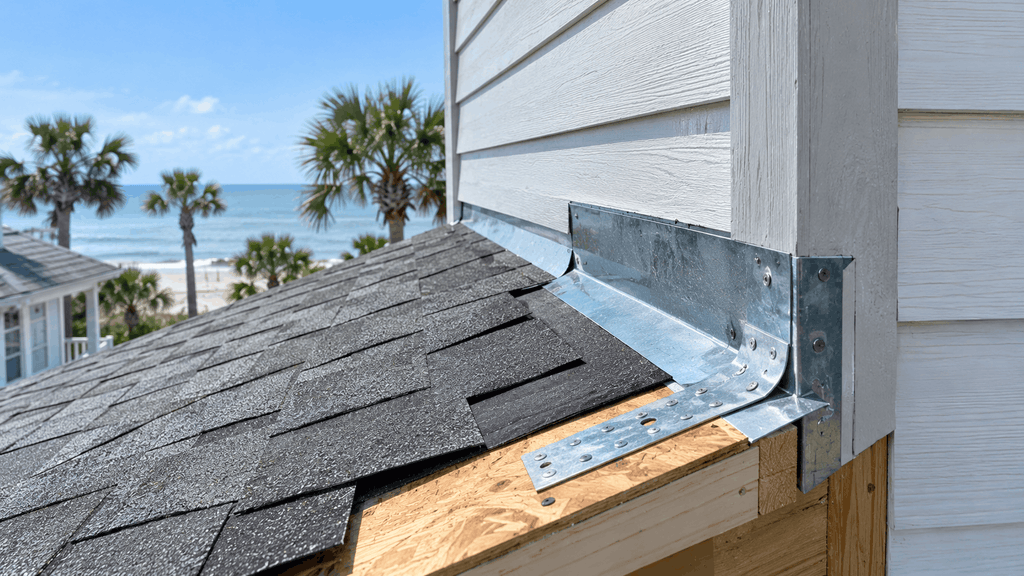
Wind-rated shingles and compliant underlayment address the surface layer of roof wind performance. But the ultimate structural question in a hurricane is whether the roof deck itself stays attached to the framing — and whether the framing stays connected to the walls. These connections are the structural foundation on which all surface-layer wind performance depends.
Roof Deck Attachment
The roof deck — typically OSB or plywood panels fastened to the roof framing — must be attached with fasteners of adequate size and spacing to resist the wind uplift pressures that a major hurricane generates at the deck level. Standard prescriptive code fastening for roof decking uses 8d common nails at 6-inch spacing in the field and 6-inch spacing at edges. High-wind zone requirements for Galveston increase the fastening requirements — shorter nail spacing, ring-shank nails, or additional fasteners at the perimeter zones where uplift pressures are highest.
When a Galveston roof replacement reveals a deck with inadequate fastening — visible from inside the attic as nails that have pulled through the deck or that are spaced too widely — addressing the deck fastening as part of the roof replacement project adds minimal cost but meaningfully improves the structure’s overall wind resistance.
Hurricane Straps and Roof-to-Wall Connections
The connection between the roof framing and the wall framing — where the rafters or trusses bear on the wall top plate — is the structural joint most commonly responsible for catastrophic roof loss in major hurricanes. Standard toe-nail connections, used in most pre-1994 residential construction, provide modest resistance to the uplift forces that a Category 3 hurricane generates at this joint. Hurricane straps — metal connectors that wrap from the rafter or truss down to the wall stud — provide dramatically better uplift resistance and are required by current building codes in Galveston’s wind zone.
When a roof replacement exposes the attic space for work, it creates an opportunity to add hurricane straps to existing framing connections at minimal incremental cost — an upgrade that may qualify for significant TWIA or private carrier insurance premium discounts. Our roofing team assesses existing roof-to-wall connections during every replacement project and provides homeowners with the information they need to make this decision.
As discussed in our post-storm restoration guide, the restoration period after storm damage is the most cost-effective moment to incorporate these structural improvements — and a planned roof replacement is the next-best opportunity.
Choosing Between Shingles and Metal for Galveston Roof Replacement
For Galveston homeowners evaluating a roof replacement, the choice between high-wind asphalt shingles and metal roofing is the defining material decision. Both can perform appropriately in Galveston’s storm environment when correctly specified and installed — the decision comes down to budget, aesthetic preference, lifespan expectations, and insurance considerations.
High-wind asphalt shingles at the Class H rating level represent the most cost-effective upfront option for homeowners who need a TWIA-compliant replacement and are working within budget constraints. Their lifespan in Galveston’s coastal environment — fifteen to twenty years for premium products — is shorter than metal but their lower installed cost allows for planned replacement within a reasonable ownership horizon.
Standing seam metal roofing — the subject of our dedicated metal roofing for coastal Texas homes guide — offers significantly longer service life, superior wind resistance through its concealed fastener system, Class A fire rating, and potential insurance premium advantages. Its higher upfront installed cost is offset by the reduced frequency of replacement over a long ownership horizon. For Galveston homeowners planning to own their property for twenty or more years, the lifecycle cost case for metal over asphalt is compelling.
The Insurance Institute for Business and Home Safety has conducted extensive research on roof performance in hurricane conditions — research that directly informs the FORTIFIED Roof standard and provides homeowners with objective data on which roofing systems and installation methods deliver the best performance in major wind events.
What the Roof Replacement Process Looks Like in Galveston
A roof replacement on a Galveston coastal home, performed to the standards described above, follows a sequence that differs meaningfully from a standard inland residential roofing job:
- Permit application with the City of Galveston — required for all roof replacements and covering both the structural work and the wind zone compliance requirements
- TWIA product selection from the current approved products list, matched to the home’s specific requirements and aesthetic preferences
- Deck inspection and repair upon tear-off, identifying any damaged, delaminated, or inadequately fastened deck panels requiring replacement before new underlayment is installed
- Hurricane strap assessment in the attic, with documentation of existing connection condition and recommendations for any supplemental connection work
- Self-adhering underlayment installation per TWIA placement requirements — fully covering the deck or at minimum the eave, valley, and hip zones
- Shingle installation in the enhanced six-nail pattern with properly placed starter strips at all edges
- TWIA post-installation inspection — scheduled and managed by Royal Coastal Builders as part of the project scope, producing the inspection certificate that documents TWIA compliance for the homeowner’s insurance file
For homeowners whose roof replacement follows storm damage, the insurance claim process runs concurrently with the replacement scope. Our roofing team has extensive experience working within insurance claim scopes on Galveston roof replacements — documenting damage correctly, scoping the replacement accurately, and coordinating with adjusters to ensure the full replacement cost is recovered within the policy limits.
Making the Right Roof Replacement Decision for Your Galveston Home
Roof replacement in Galveston is one of the most significant investments a coastal homeowner makes in the protection of their property. Getting it right — choosing the correct wind rating, specifying the installation details that make the rating real, meeting TWIA compliance requirements, and addressing the structural connections that the roof depends on — requires a roofing contractor with genuine coastal expertise and a full understanding of Galveston’s specific regulatory and insurance environment.
The National Roofing Contractors Association provides homeowner resources on roof replacement selection and contractor qualification standards that are useful for evaluating any roofing contractor regardless of location — a baseline that Galveston’s coastal requirements build significantly upon.
Royal Coastal Builders has been performing roof replacements on Galveston Island for years, with the TWIA recognition, coastal material expertise, and full-service construction capability that this market demands. Every roof replacement we complete is permitted, inspected, and documented to the standards that protect Galveston homeowners’ investments and their insurance coverage.
Ready to plan your Galveston roof replacement? Contact Royal Coastal Builders at (409) 996-2273 or visit royalcoastalbuilders.com/contact to schedule a roofing assessment with our coastal team today.