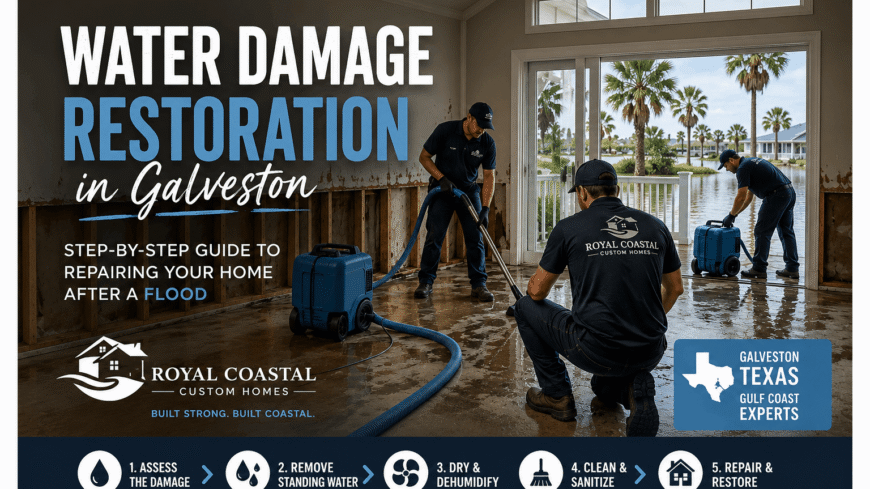
Water damage restoration in Galveston is one of the most time-sensitive and technically demanding processes a coastal homeowner can face. When floodwater enters a home — whether from hurricane storm surge, bay flooding, a storm-driven rain event, or an inland drainage failure — every hour that passes without action increases the scope of structural damage, accelerates the conditions for mold growth, and raises the ultimate cost of full recovery.
Galveston’s position at sea level on a barrier island makes flood exposure one of the baseline risks of homeownership here. The island has experienced major flooding events from hurricanes, tropical storms, and even strong winter systems over decades of recorded history. For homeowners who live here, the question is not whether flooding could affect their property — it is how to respond correctly and completely when it does.
This guide walks through the full water damage restoration process for Galveston homes, from the immediate post-flood assessment through structural drying, material salvage decisions, system inspections, and the final restoration that returns a water-damaged home to safe, full occupancy.
Understanding Flood Water Categories — Why It Matters for Restoration
Not all floodwater is the same, and the category of water that entered your Galveston home has direct implications for what materials can be salvaged, what must be replaced, and what health precautions apply during cleanup. The Institute of Inspection, Cleaning and Restoration Certification (IICRC) classifies water intrusion into three categories:
- Category 1 — Clean Water: Water from a sanitary source — a broken supply line, a clean rainwater intrusion through the roof, or a malfunctioning appliance. Category 1 water carries the lowest contamination risk and allows the broadest range of material salvage options if drying begins promptly.
- Category 2 — Gray Water: Water that carries some level of contamination — discharge from washing machines or dishwashers, toilet overflow without fecal matter, or floodwater that has been standing long enough to begin biological degradation. Category 2 water requires more aggressive remediation and limits material salvage more significantly than Category 1.
- Category 3 — Black Water: Highly contaminated water from sewage backup, storm surge, rising floodwater from waterways, or any water source that has contacted soil or sewage systems. Category 3 water is the most common category in Galveston flood events — storm surge and bay flooding bring whatever is in those waterways directly into the home. Black water intrusion requires the most extensive remediation, including replacement of all porous materials that were in contact with the water, regardless of how dry they appear after extraction.
For most Galveston flooding events driven by hurricane storm surge or bay flooding, homeowners should assume Category 3 contamination until a professional assessment confirms otherwise. This assumption drives the remediation decisions that follow.
Step 1: Confirm Safety Before Re-Entry
The same safety priorities that apply to any storm event apply with additional urgency when floodwater has been present in a home. Before entering a flood-affected Galveston property:
- Confirm utility safety. Floodwater and electrical systems are a lethal combination. Do not enter a flooded home until the utility company has confirmed power to the property has been shut off at the meter, or until a licensed electrician has confirmed the electrical system is safe to operate. Never assume the absence of visible arcing or sparks means the system is safe.
- Check for structural compromise. Floodwater exerts significant lateral pressure on wall systems and foundations. A home that has sustained significant flood depth may have wall framing that has moved, foundation connections that have been compromised, or structural elements that are no longer safe to load. If the exterior shows visible structural distortion, do not enter without a professional assessment.
- Use personal protective equipment for Category 3 water. Black water contact carries genuine health risk from bacteria, sewage pathogens, and chemical contaminants. Rubber boots, waterproof gloves, and respiratory protection are the minimum appropriate personal protective equipment for entering a home that has had Category 3 floodwater intrusion.
- Watch for displaced wildlife. Galveston flood events displace snakes, fire ants, and other wildlife that seek shelter in elevated structures — including inside flood-affected homes. Look before stepping and moving debris.
Step 2: Document Everything Before Touching Anything
As covered in our post-storm restoration guide, comprehensive documentation before any cleanup or extraction begins is the foundation of a successful insurance claim. For water damage specifically, documentation priorities include:
- Waterline marks on walls showing the maximum flood depth in each room — photograph these with a measuring tape showing the height from the floor, as flood depth directly affects the scope of wall material removal that is required and what your insurance adjuster will authorize
- All affected flooring, cabinetry, and built-in elements before any removal
- All mechanical equipment — water heaters, HVAC components, electrical panels, and appliances — that was submerged or water-contacted
- All damaged personal property with photos, descriptions, and model or serial numbers where available
- The exterior of the home showing flood waterlines on the foundation and siding, and any visible structural or cladding damage
Time-stamped photos and video are significantly more valuable than undated documentation. Enable timestamps on your device before beginning.
Step 3: Water Extraction — Speed Is the Critical Variable
Once safety is confirmed and documentation is complete, water extraction begins. In Galveston’s warm, humid climate, the window between initial flood intrusion and the onset of mold colonization is as short as 24 to 48 hours. Standing water that remains in the structure beyond that window does not simply extend the drying timeline — it actively initiates biological processes in building materials that cannot be reversed by drying alone.
Professional water extraction uses equipment that operates at a fundamentally different scale than anything available to homeowners:
- Truck-mounted or portable extraction units capable of removing hundreds of gallons per hour from flooring systems, wall cavities, and structural assemblies — far beyond what wet-dry vacuums or consumer equipment can achieve
- Submersible pumps for areas with significant standing water depth before extraction equipment can access the surface
- Weighted extraction tools for carpet and pad, which hold many times their weight in water and cannot be adequately extracted with surface-only equipment
For Galveston flooding events involving Category 3 water, carpet, carpet pad, and most vinyl flooring must be removed entirely rather than extracted and dried in place — these materials cannot be effectively decontaminated after black water contact, and attempting to dry them in place creates a mold and pathogen substrate within the floor assembly.
Step 4: Structural Drying — The Science of Getting It Right
Water extraction removes standing and surface water. Structural drying removes the moisture that has been absorbed into building materials — the wood framing, drywall, insulation, and subfloor systems that will continue to support mold growth and structural degradation if moisture remains within them even after the visible water is gone.
Structural drying is a technically precise process governed by psychrometrics — the science of air moisture content and the conditions under which materials release absorbed moisture into the air. Effective structural drying in a Galveston flood environment requires:
- Industrial dehumidifiers placed to process the air volume of the affected space continuously — consumer dehumidifiers are not rated for the moisture loads or air volumes involved in structural drying after a flood event
- High-velocity air movers positioned to create the air circulation across wet surfaces that accelerates surface evaporation and draws moisture from within building materials toward the surface where dehumidifiers can capture it
- Moisture monitoring of structural materials using pin and pinless meters to track drying progress within wall assemblies, subfloor systems, and framing — confirming that structural members have reached acceptable moisture content before any enclosure or reinstallation
- Psychrometric calculations to verify that the temperature, relative humidity, and air movement conditions in the drying environment are actually producing the evaporation rates the restoration timeline requires
In Galveston’s climate, achieving target drying conditions requires maintaining elevated indoor temperatures while running dehumidifiers continuously — the opposite of the natural instinct to open all windows and let coastal air do the work. Coastal air in Galveston carries too much moisture to effectively dry a flood-affected structure; introducing it during the drying phase can actually slow the process significantly.
Typical structural drying timelines for a Galveston flood event range from three to five days for moderate intrusion with prompt extraction, to ten days or more for significant flood depth or delayed extraction. Our emergency services team monitors drying progress with daily moisture readings and adjusts equipment placement to meet drying goals as efficiently as possible.
Step 5: Material Salvage Decisions — What Stays and What Goes
One of the most consequential decisions in water damage restoration is determining which building materials can be effectively dried and retained and which must be removed and replaced. These decisions are driven by the water category, the depth and duration of flood exposure, and the material’s capacity to be decontaminated and dried to acceptable moisture content.
Drywall
Standard drywall has a paper facing that supports mold growth readily and a gypsum core that absorbs and retains moisture. For Category 3 water intrusion, drywall that was in contact with floodwater is almost universally removed. The standard practice is to cut drywall to a minimum of 12 inches above the documented waterline — and often higher if moisture readings indicate that wicking has carried moisture above the visible flood mark. This approach, sometimes called the flood cut, exposes the wall cavity framing for inspection, drying, and antimicrobial treatment before new drywall is installed.
Insulation
Fiberglass batt insulation that has been wetted by floodwater loses its R-value when wet and does not fully recover it when dried. For Category 3 water intrusion, batt insulation in contact with floodwater is always removed — it cannot be effectively decontaminated and retains moisture that will support ongoing mold growth within the wall cavity even if the drywall and framing appear dry.
Closed-cell spray foam insulation responds differently — it does not absorb water significantly and can often be cleaned and retained if the framing behind it is confirmed dry. This is one of the documented performance advantages of closed-cell spray foam in coastal flood zone applications, as discussed in our energy-efficient coastal construction guide.
Wood Framing
Structural framing that has been wetted by floodwater can typically be dried and retained if moisture content can be brought to acceptable levels — generally below 19 percent for wood framing — and if no structural compromise is identified. Framing that shows signs of pre-existing rot, biological growth, or fastener failure during the post-flood inspection should be replaced regardless of moisture status.
Cabinetry and Millwork
Kitchen and bathroom cabinetry with particleboard or MDF box construction is generally not salvageable after Category 3 water intrusion. These materials absorb water rapidly, swell, and cannot be effectively dried without structural failure. Solid wood or plywood-box cabinetry may be salvageable if exposure was limited and drying begins promptly, but this is an assessment decision made case by case based on the specific product and exposure conditions.
Step 6: Antimicrobial Treatment and Mold Prevention
Once materials have been removed to the appropriate extent and structural framing is exposed and drying, antimicrobial treatment of all exposed surfaces is applied before any reinstallation begins. This step addresses the mold spore population that was introduced with Category 3 floodwater and that has begun to establish on organic surfaces during the period between flood intrusion and remediation.
Antimicrobial treatment in a professional water damage restoration process involves:
- Application of EPA-registered antimicrobial agents to all exposed framing, subfloor, and structural surfaces — not consumer-grade products that do not meet the efficacy standards required for Category 3 water intrusion remediation
- Thorough coverage of all exposed organic surfaces, including joist bays, wall cavity framing, and the back surfaces of any remaining building components
- A defined dwell time for the antimicrobial agent before enclosure begins, confirming the treatment has had adequate contact time to achieve its rated efficacy
For a thorough understanding of why mold prevention in this stage is so critical in Galveston’s climate — and what happens when it is skipped or performed inadequately — our guide to mold remediation and prevention for Gulf Coast homes covers the science in detail.
Step 7: Electrical, Plumbing, and HVAC System Inspections
Structural drying and material remediation address the building envelope. But water damage to mechanical and electrical systems in a Galveston home requires separate, system-specific professional inspection before the home can be safely occupied or enclosed.
Electrical System
Any electrical component that was submerged in floodwater — panels, outlets, switches, junction boxes, and wiring — requires inspection and testing before the system is re-energized. Submersion introduces moisture into components designed to be dry, corrosion into connections designed to be clean, and contaminants into insulation designed to be intact. Our electrical team performs comprehensive post-flood electrical assessments, identifying components that require replacement versus those that can be cleaned, tested, and returned to service.
Plumbing System
Floodwater intrusion can displace, pressurize, and contaminate plumbing systems in ways that are not visible from the surface. Water heaters and softeners that were submerged require replacement — their internal components and insulation cannot be effectively decontaminated after Category 3 water contact. Drain lines should be inspected for sediment accumulation and joint displacement from flood pressure before the home is returned to use. Our plumbing team conducts post-flood system inspections as part of every full water damage restoration scope.
HVAC System
HVAC equipment submerged in floodwater presents both performance and health risks if returned to service without proper assessment. Air handlers that were wetted can distribute mold spores and bacterial contaminants through the home’s ductwork with every cycle. Ductwork that was submerged or that had floodwater enter through grilles and registers requires cleaning or replacement before the system is operated. Our HVAC team evaluates all mechanical system components for post-flood condition and provides clear guidance on what can be cleaned and tested versus what must be replaced.
Step 8: Restoration and Rebuilding — Smarter Than Before
The final stage of water damage restoration is rebuilding the affected areas — and this stage presents the most cost-effective opportunity available to Galveston homeowners to make meaningful improvements to their home’s flood resistance at the same time.
When walls are already open, insulation is already removed, and mechanical systems are already being replaced, the incremental cost of building back better is a fraction of what the same upgrades would cost as standalone projects. Improvements worth incorporating during restoration include:
- Closed-cell spray foam insulation replacing standard batt insulation in wall and roof assemblies, providing both energy performance improvement and significantly better flood resilience for future events
- Moisture-resistant drywall — cement board or fiberglass-faced gypsum products — in areas at or below the flood risk elevation, replacing standard paper-faced drywall that is first to fail in future water intrusion events
- Elevated mechanical equipment repositioned above the base flood elevation during restoration, protecting HVAC, electrical panels, and water heaters from damage in future flood events
- Flood-resistant flooring materials — large-format porcelain tile or waterproof luxury vinyl plank — replacing flooring types that will require full replacement in any future flood event
These choices do not simply restore what was damaged — they build a home that is genuinely more resilient to the next flood event, which on Galveston Island is a realistic planning consideration for every homeowner.
The Federal Emergency Management Agency’s flood damage repair guidance provides homeowners with the framework for understanding repair scope relative to pre-flood property value — an important document for any Galveston homeowner navigating the substantial improvement threshold in a Special Flood Hazard Area.
Choosing the Right Water Damage Restoration Contractor in Galveston
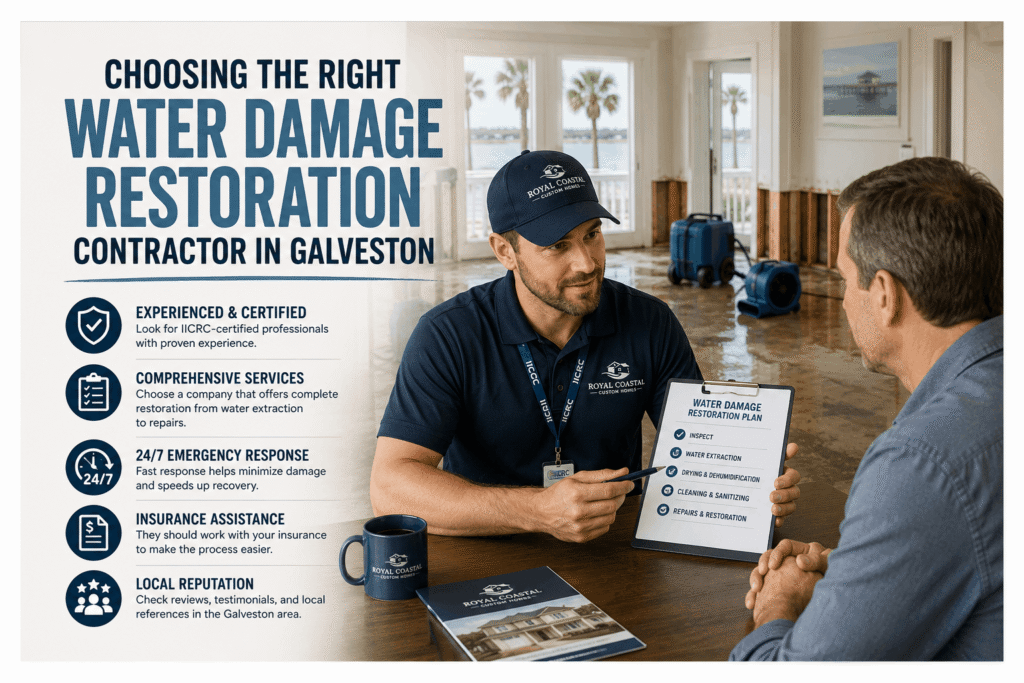
Water damage restoration in Galveston requires a contractor with demonstrated experience in the specific conditions of Gulf Coast flooding — Category 3 water intrusion from storm surge or bay flooding, the coastal humidity environment that extends drying timelines, the FEMA flood zone compliance requirements that govern how restoration work is permitted, and the insurance claim process that determines what Galveston homeowners can actually recover financially.
The IICRC S500 Standard for Professional Water Damage Restoration establishes the professional framework for water damage restoration work — homeowners evaluating contractors should ask whether the firm follows IICRC S500 protocols and whether their technicians hold relevant IICRC certifications.
Royal Coastal Builders brings over 50 years of combined coastal construction experience to every water damage restoration project on Galveston Island — with the full-service capability to manage extraction, drying, material remediation, system inspections, and complete restoration under one team, and the insurance claim experience to support homeowners through the documentation and settlement process from start to finish.
Water damage restoration in Galveston is not simply a cleanup job. It is a building science process with strict timelines, material science decisions, and long-term structural implications that demand the right expertise at every stage.
If your Galveston home has sustained flood or water damage, contact Royal Coastal Builders immediately at (409) 996-2273 or visit royalcoastalbuilders.com/contactto schedule an emergency assessment today.