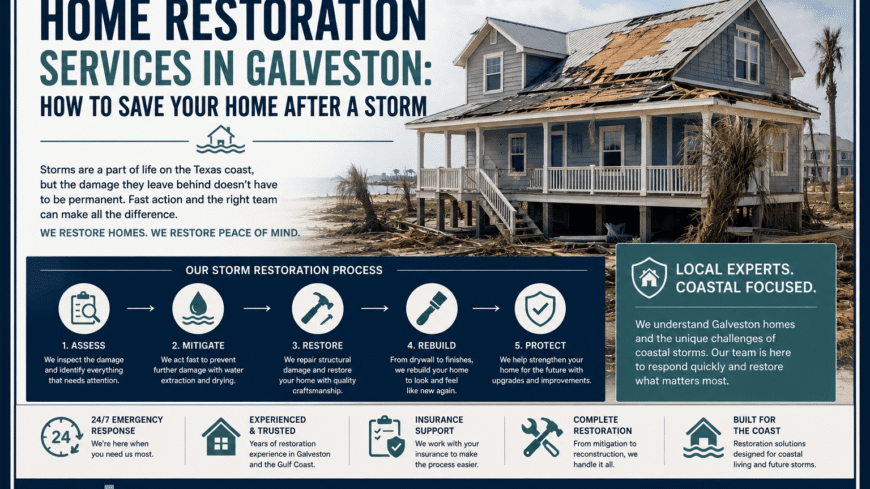
When a Gulf Coast storm passes and the skies finally clear over Galveston Island, the recovery process begins — and the decisions made in the first hours, days, and weeks after a storm determine how completely and how quickly a damaged home can be restored. Home restoration services in Galveston are not simply about fixing what broke. They are about moving through a complex, time-sensitive process correctly, in the right order, with the right documentation and the right contractor — so that a damaging storm event does not become a financial catastrophe on top of a physical one.
Galveston homeowners face storm risk every season. The island’s location on the Gulf of Mexico makes it one of the most hurricane-exposed communities in the continental United States, and every tropical season brings the real possibility of wind damage, storm surge, flooding, and the cascading structural and mechanical failures that follow major weather events. Understanding what to do — and what not to do — when your home sustains storm damage is one of the most important things a Galveston homeowner can know.
This guide walks through the complete post-storm restoration process, from the immediate safety assessment to final repairs and storm-hardening upgrades that reduce risk for the future.
Step 1: Safety First — What to Do Before You Enter Your Home
After any significant storm event, the impulse to return to your property as quickly as possible is understandable. But re-entering a storm-damaged home before it has been assessed for safety hazards can put you in more danger than the storm itself. Before entering your Galveston home after a hurricane or major storm:
- Wait for official re-entry clearance. The City of Galveston and Galveston County issue re-entry authorizations after major storm events. Attempting to return before clearance is issued is not only potentially dangerous — it may also be illegal during active emergency orders.
- Assess the exterior from a safe distance before entering. Look for visible structural damage to the roof, foundation, or walls. A visibly compromised structure may not be safe to enter regardless of how it looks from the street.
- Check for utility hazards before going inside. Downed power lines near the property, the smell of gas, or standing water inside the home are all signals to keep out and contact utilities before proceeding.
- Document everything you can see from the exterior before touching anything. Photographs and video taken before any cleanup or temporary repairs begin are critical for insurance claims. Time-stamped documentation is significantly more valuable than photos taken after cleanup has started.
- Do not operate electrical switches or appliances if the home has experienced flooding or has had water intrusion until the electrical system has been inspected by a licensed electrician.
Safety assessment is the mandatory first step in any post-storm restoration process, and it is never something to rush.
Step 2: Document All Damage Thoroughly Before Any Cleanup
Documentation is the foundation of a successful insurance claim, and insufficient documentation is the most common reason Galveston homeowners receive less than they are entitled to after a storm. Before any debris removal, emergency tarping, or cleanup begins, document every element of storm damage as completely as possible:
- Photograph every room, every damaged surface, every broken fixture, and every point of water intrusion — interior and exterior — with timestamps active on your device
- Video walkthrough of the entire property, narrating what you observe as you move through each space
- Document all personal property that was damaged — furniture, appliances, electronics, stored items — with photos and, where possible, receipts or model numbers that support replacement value claims
- Do not dispose of any damaged materials until your insurance adjuster has had the opportunity to inspect them. Damaged roofing shingles, wet insulation, destroyed cabinetry — all of it is evidence that supports your claim.
- Keep a written log of all storm-related events, including the date and time the storm passed, when you were first able to return to the property, what you observed on return, and every action taken from that point forward
This documentation discipline protects your claim and gives the Royal Coastal Builders emergency services team the information needed to provide an accurate scope of work when they conduct their own damage assessment.
Step 3: Emergency Stabilization — Stopping Further Damage
Once safety and documentation are addressed, the priority shifts to stopping any ongoing damage. Water intrusion through a compromised roof, broken windows, or storm-damaged walls causes cascading secondary damage — soaking insulation, saturating wall assemblies, migrating into flooring systems, and creating conditions for mold growth that can begin within 24 to 48 hours of initial water exposure in Galveston’s humid climate.
Emergency stabilization measures commonly needed after Gulf Coast storm events include:
- Roof tarping over damaged areas — properly installed emergency tarps cover exposed roof decking or compromised sections until permanent roofing repairs can be scheduled. Tarps installed incorrectly or too loosely can be blown off in subsequent weather events, compounding the problem.
- Window and door boarding for openings where impact glass has failed or frames have been damaged, preventing additional wind-driven rain from entering the structure
- Water extraction from flooded or water-intruded interior spaces, using commercial extraction equipment that removes water from flooring systems and wall cavities more completely than household methods
- Structural shoring of compromised walls or roof sections that are at risk of further collapse in the post-storm period
Emergency stabilization work must be performed by experienced contractors, and the costs incurred are typically claimable under your homeowners insurance policy as emergency mitigation expenses. Keep all receipts and document all work performed, as these costs are submitted as part of your overall claim.
Step 4: Contact Your Insurance Company — What to Know First
Navigating the insurance claim process after a Galveston storm event is a critical step that significantly affects the financial outcome of the restoration. The following practices improve claim outcomes and help avoid the most common mistakes Galveston homeowners make when filing storm damage claims:
- File your claim as promptly as possible. After a significant storm event that affects many Galveston properties simultaneously, insurance companies receive large volumes of claims. Filing early positions you for earlier adjuster scheduling and avoids the backlog that develops in the days following a major hurricane.
- Request a copy of your policy before the adjuster arrives. Know what your coverage includes, what your deductible is, and whether you have separate hurricane or wind deductibles — which are common in Texas coastal policies and are separate from the standard deductible.
- Understand the 50 percent rule before authorizing extensive repairs. Under FEMA’s substantial improvement rule, if repairs to a structure in a Special Flood Hazard Area exceed 50 percent of the home’s pre-storm market value, the home may be required to be brought into full compliance with current flood zone construction standards — which can include elevating the structure. This is a critically important threshold in Galveston’s flood-zone environment, as discussed in detail in our FEMA Flood Map guide for Galveston homeowners.
- Do not accept the initial settlement without review. Insurance adjusters work for the insurance company. Their initial assessment may not capture the full scope of damage, particularly for structural damage that is not visible from the surface. Having an independent contractor assessment — from a team like Royal Coastal Builders — gives you documentation to support a complete claim or supplement if the initial offer is insufficient.
- Work with a contractor experienced in insurance claim navigation. The repair scope submitted to your insurer shapes what you are paid. A contractor who understands how to document and present storm damage correctly is a material advantage in the claim process.
The Texas Department of Insurance provides guidance on homeowner rights in the claims process, including the timeline insurers must follow for acknowledging, investigating, and paying claims under Texas law.
Step 5: Assess the Full Scope of Damage Across All Systems
Storm damage to a Galveston home rarely stops at the obvious surface damage. A thorough restoration requires assessing damage across every building system — not just what is visible after initial inspection. Systems that commonly sustain hidden damage in Gulf Coast storm events include:
Roofing and Structural Systems
Wind damage to roofing often extends beyond the visible missing shingles or displaced panels. Roof decking can be partially lifted and re-seated by wind uplift without appearing obviously damaged from the ground, but the fastener pull-through and deck delamination that result create ongoing leak paths that appear weeks or months after the storm. Our roofing team conducts full deck inspections — not just surface assessments — on every post-storm evaluation.
Electrical Systems
Water intrusion and flood exposure can damage wiring, panels, junction boxes, and outlets throughout a home — including in areas that do not appear obviously wet. Electrical systems in flood-affected Galveston homes require inspection and testing by a licensed electrician before power is restored or the home is occupied. Our electrical team performs complete post-storm electrical assessments as part of the full restoration scope.
Plumbing Systems
Storm surge and flooding can displace, crack, or contaminate plumbing components. Water heaters, pressure regulators, and supply lines submerged in floodwater typically require replacement rather than cleaning. Sewer line integrity should also be assessed after significant storm events, as ground movement and surge pressure can damage underground piping that is not immediately visible. Our plumbing specialists assess all plumbing systems as part of a complete restoration evaluation.
HVAC Systems
Air handling equipment, outdoor condenser units, and ductwork all require inspection after a storm event. Flood-submerged HVAC components present health risks if operated without remediation, as standing water in air handlers and ductwork creates conditions for mold and bacterial growth that then circulates through the home’s air supply. Our HVAC team evaluates all mechanical systems during the restoration assessment process.
Step 6: Prioritize Mold Prevention in Galveston’s Humid Climate
Mold is one of the most consequential secondary threats following water intrusion in a Galveston home. The combination of organic building materials, persistent coastal humidity, and warm temperatures creates near-ideal conditions for mold colonization — which can begin within 24 to 48 hours of initial water exposure and spread rapidly through wall assemblies, insulation, and structural framing if not addressed.
Effective mold prevention in post-storm restoration requires:
- Rapid water extraction from all affected areas using commercial-grade equipment
- Controlled drying of wall assemblies, flooring systems, and structural framing using industrial dehumidifiers and air movers — not simply opening windows and hoping the coastal air dries the structure out
- Removal of saturated materials that cannot be effectively dried in place — drywall, insulation, carpet, and some flooring systems typically require removal rather than drying when they have been significantly wetted
- Antimicrobial treatment of exposed framing and structural surfaces before any enclosure or reinstallation
- Air quality testing following remediation to confirm mold counts have returned to acceptable baseline levels before the home is occupied or finished materials are reinstalled
Attempting to dry a storm-flooded Galveston home using household fans and natural ventilation is rarely sufficient in the coastal humidity environment, and homes that appear dry on the surface can harbor sustained moisture in wall assemblies for weeks — long enough for significant mold colonization to establish.
Step 7: Restore with Storm-Hardening Upgrades in Mind
Post-storm restoration is the most cost-effective moment to upgrade a Galveston home’s storm resistance — because the walls are already open, the roofing is already being replaced, and the incremental cost of a better specification is a fraction of what it would cost as a standalone improvement project.
Storm-hardening upgrades that Royal Coastal Builders routinely incorporates during restoration projects include:
- Impact-resistant windows and doors replacing standard glass that failed or would fail in a future storm event — impact glazing eliminates the need for storm shutters and maintains the home’s envelope integrity without occupant action before a storm
- Hurricane straps and improved roof-to-wall connections installed during roof replacement, significantly improving wind uplift resistance at the most common point of structural failure in Gulf Coast hurricanes
- Closed-cell spray foam insulation replacing standard batt insulation in wall and roof assemblies — providing not only better energy performance but also improved structural rigidity and moisture resistance
- Elevated mechanical systems repositioned above the base flood elevation during restoration, protecting HVAC, electrical panels, and water heaters from future flood damage
- Fiber cement or engineered wood exterior cladding replacing materials that failed in wind-driven rain, specifying products rated for coastal wind and moisture exposure
These upgrades do not simply repair what was damaged — they reduce the scope and cost of restoration the next time a storm affects the property, which on Galveston Island is a question of when, not if.
Choosing the Right Home Restoration Contractor in Galveston
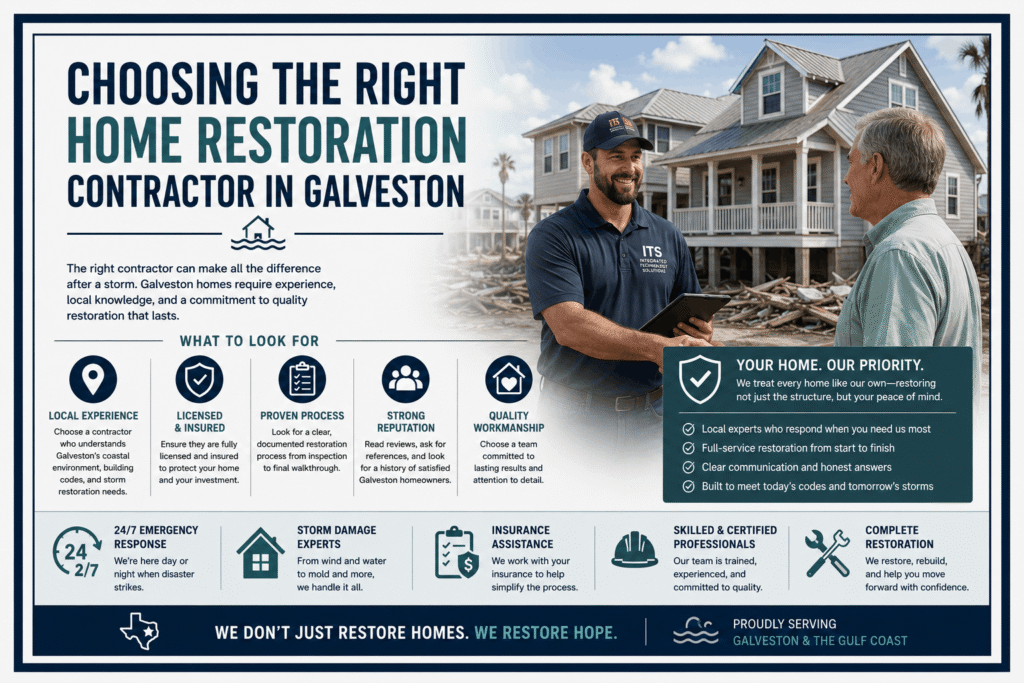
After a major storm, Galveston is invariably visited by out-of-area contractors — sometimes called storm chasers — who pursue post-disaster work with aggressive pricing and promises of fast turnaround. Choosing an unfamiliar out-of-area contractor for post-storm restoration carries significant risks, particularly on the Gulf Coast where local code knowledge, flood zone requirements, and insurance claim experience are essential to a complete and compliant restoration.
When selecting a home restoration contractor in Galveston after a storm, look for:
- Local presence and established community track record — a contractor who has operated in the Galveston market for years, not one who arrived after the storm
- Licensed and insured for Texas coastal construction, including the specific permit and inspection requirements that apply to storm damage repairs in Galveston’s flood zones
- Experience navigating homeowners insurance claims for storm damage, including the documentation, scope writing, and supplemental claim processes that maximize what you recover
- Full-service capability — roofing, structural, electrical, plumbing, HVAC, and interior restoration under one team, eliminating the coordination failures that arise when multiple subcontractors with no shared accountability work on the same property
Royal Coastal Builders has served Galveston Island homeowners through multiple major storm events, providing emergency restoration services from initial damage assessment through complete home restoration. We are licensed, insured, and deeply familiar with the specific demands of post-storm recovery in Galveston’s coastal flood zone environment.
Home restoration services in Galveston require a team that knows this island, knows these codes, and knows how to get you from storm damage back to a fully restored, storm-hardened home as efficiently as possible.
If your Galveston home has sustained storm damage, contact Royal Coastal Builders at (409) 996-2273 or visit royalcoastalbuilders.com/contactto schedule an emergency assessment with our restoration team today.