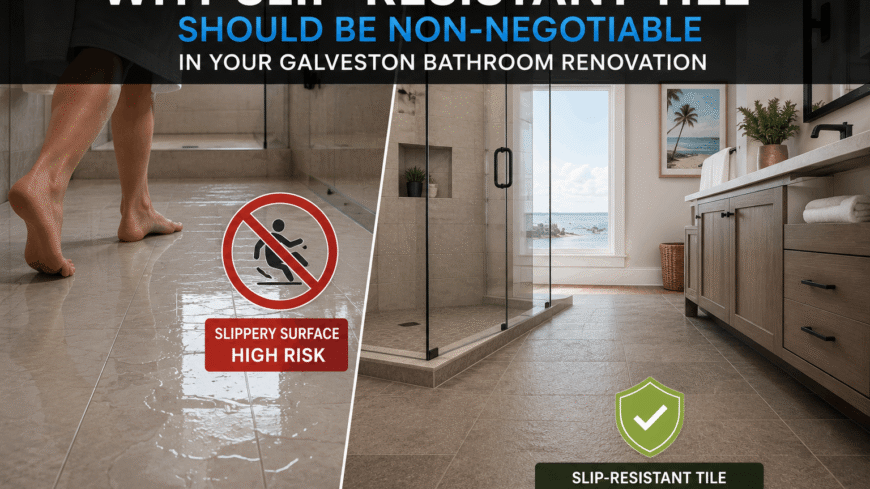
Anyone planning a Galveston bathroom renovation eventually has to make a decision about flooring, and few decisions carry more real-world consequence than tile selection in a wet space. It is easy to focus entirely on color, pattern, and finish when choosing bathroom tile. But on the Texas Gulf Coast, where humidity is constant and bathrooms see heavier use from sandy feet, swimsuits, and frequent showers after time on the water, slip resistance deserves equal weight in the decision — and arguably more.
A beautiful bathroom that creates a fall hazard is not a successful renovation. Slip-and-fall injuries in residential bathrooms are among the most common causes of home injury, and the risk increases substantially in coastal homes where moisture exposure is higher and more frequent than in a typical inland residence. The good news is that slip resistance and beautiful design are not mutually exclusive. With the right tile selection and a clear understanding of what slip ratings actually mean, you can have both safety and style in your renovated coastal bathroom.
This guide explains why slip-resistant tile matters so much in a Galveston bathroom renovation, how to evaluate tile slip ratings, and which materials deliver the best combination of safety, durability, and design in a coastal environment.
Why Coastal Bathrooms Carry Higher Slip Risk
A bathroom in a Galveston beach home faces moisture conditions that differ meaningfully from a bathroom in an inland Texas home, and understanding why helps explain why slip resistance deserves special attention in any Galveston bathroom renovation.
Several coastal-specific factors compound slip risk:
- Higher ambient humidity means bathroom floors take longer to dry between uses, extending the window of time the surface remains wet and hazardous
- Sand and grit tracked in from the beach create an additional slip mechanism beyond water alone — wet sand on a smooth tile surface is significantly more hazardous than water by itself
- Frequent rinsing of swimsuits, beach gear, and sandy feet in beach house bathrooms means these spaces see more direct water contact on the floor than a typical primary residence bathroom
- Guest and rental turnover in many Galveston vacation homes means more people, often unfamiliar with the space, using the bathroom under conditions where they are less attentive to footing
These factors combine to make slip resistance a genuine safety priority rather than a secondary design consideration in any coastal bathroom project.
Understanding Tile Slip Resistance Ratings
Tile slip resistance is measured using a standardized metric called the Coefficient of Friction (COF). Understanding this rating system helps you evaluate tile options with real data rather than guesswork or showroom assumptions.
The two primary standards used in the tile industry are:
- DCOF (Dynamic Coefficient of Friction) — the current industry standard, measured under the ANSI A137.1 testing protocol. The American National Standards Institute and the Tile Council of North America recommend a minimum DCOF of 0.42 for tile used in level interior floor spaces that may become wet, including bathroom floors.
- SCOF (Static Coefficient of Friction) — an older measurement standard that has largely been replaced by DCOF testing but is still referenced on some older tile specification sheets
For a Galveston bathroom renovation, a DCOF rating of 0.42 should be treated as an absolute minimum, not a target. Given the elevated moisture exposure coastal bathrooms experience, many contractors — including the team at Royal Coastal Builders — recommend specifying tile with a DCOF rating closer to 0.60 or higher for shower floors and wet zone areas, where water contact is most frequent and direct.
It is worth noting that DCOF testing is conducted under controlled laboratory conditions. Real-world performance can vary based on installation, grout selection, and ongoing maintenance — which is why slip resistance should be considered alongside proper installation practices, not as a standalone tile specification.
The Best Slip-Resistant Tile Materials for Coastal Bathrooms
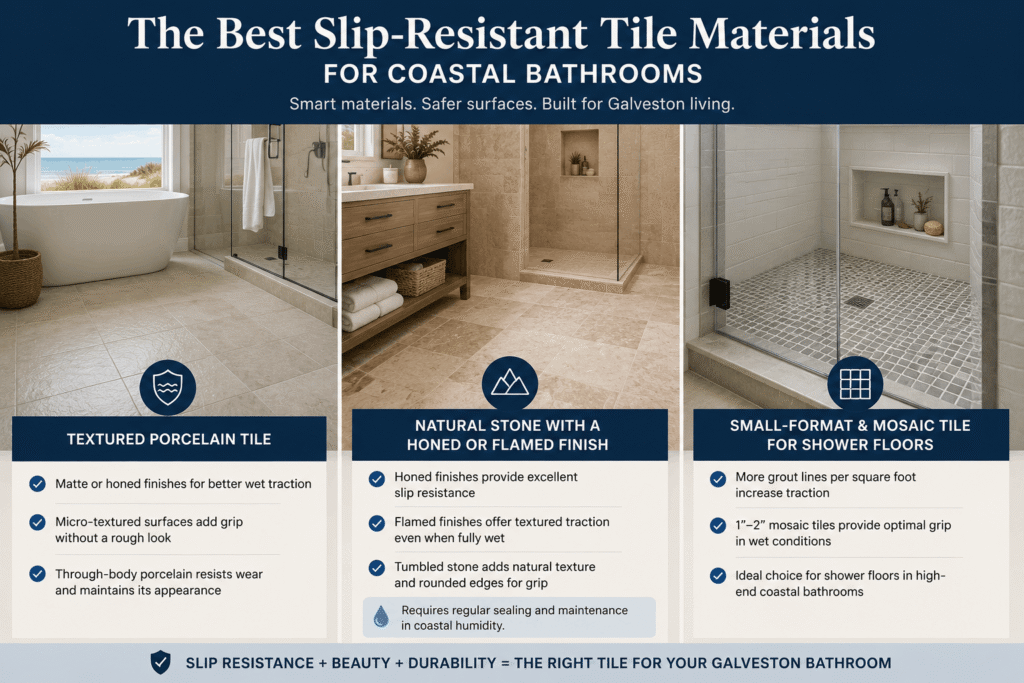
Not all tile materials achieve high slip resistance equally, and the texture, finish, and composition of the tile all play a role. Here are the materials that consistently perform best for Galveston bathroom renovations.
Textured Porcelain Tile
Porcelain remains the top recommendation for coastal bathroom floors for the same reasons it performs well throughout a kitchen remodel: near-zero water absorption, durability, and resistance to coastal humidity and salt exposure. For slip resistance specifically, textured and matte-finish porcelain options significantly outperform polished or glossy porcelain.
Look for:
- Matte or honed finishes rather than high-gloss or polished surfaces, which dramatically reduce traction when wet
- Micro-textured surfaces that add tactile grip without a visibly rough or industrial appearance
- Through-body porcelain in which color and pattern extend through the full thickness of the tile, meaning surface wear from foot traffic does not expose a different-colored substrate beneath
Natural Stone with a Honed or Flamed Finish
Natural stone such as travertine, slate, and certain limestones can deliver excellent slip resistance when finished correctly. The key distinction is finish, not material:
- Honed finishes create a matte, low-sheen surface with significantly better traction than polished stone
- Flamed or thermal finishes, commonly used on granite and some limestones, create a textured surface through controlled heat treatment that produces excellent grip even in fully saturated conditions
- Tumbled stone, particularly travertine, has naturally textured surfaces and rounded edges that provide good traction, though the porous nature of tumbled stone requires regular sealing in a coastal humidity environment
Natural stone requires more ongoing maintenance than porcelain in coastal conditions, as discussed in our guide to countertop materials for high-humidity environments, but for homeowners committed to that maintenance, properly finished stone delivers both safety and a natural aesthetic well suited to coastal design.
Small-Format and Mosaic Tile for Shower Floors
While large-format tile is the preferred choice for bathroom walls and dry floor areas, shower floors benefit from a different approach. Smaller tile formats — particularly mosaic tile in the 1-inch to 2-inch range — create significantly more grout lines per square foot than large-format tile.
This matters for slip resistance because grout itself provides traction. A shower floor composed of small mosaic tile has dramatically more grip than the same material in a large-format application, simply due to the increased frequency of grout joints across the walking surface. This is why even high-end coastal bathroom designs that use large-format porcelain throughout the rest of the bathroom often transition to a textured mosaic specifically on the shower floor.
Grout Selection and Installation Details That Affect Slip Resistance
Tile material alone does not determine the final slip resistance of an installed bathroom floor. Several installation factors materially affect real-world traction:
- Grout joint width — wider grout joints increase the frequency of traction points across the floor surface, which can meaningfully improve slip resistance, particularly with larger tile formats
- Grout texture and composition — sanded grout typically provides slightly better traction than unsanded grout due to its rougher surface texture
- Proper slope to drain — a shower floor that does not slope correctly allows water to pool rather than drain, extending the time the surface remains wet and increasing slip risk regardless of how slip-resistant the tile itself is rated
- Sealant maintenance on natural stone — as stone sealant wears down over time, slip resistance can degrade along with water resistance, making periodic resealing a safety maintenance item, not just an aesthetic one
These installation details are where experienced bathroom remodeling contractors make the difference between a tile specification that performs well on paper and a finished bathroom floor that performs well for the people actually using it.
Balancing Slip Resistance with the Design You Want
A common concern among homeowners is that prioritizing slip resistance means sacrificing the sleek, large-format, minimalist aesthetic that defines so much of current coastal bathroom design. This is largely a misconception rooted in older tile technology.
Modern tile manufacturing has closed much of the gap between high-traction texture and refined appearance:
- Large-format porcelain is now widely available in textured and matte finishes that read as sophisticated and contemporary while delivering DCOF ratings well above the 0.42 minimum
- Texture can be applied selectively — using a higher-traction tile specifically on the shower floor while maintaining a smoother, large-format tile on walls and dry areas preserves the clean aesthetic where slip risk is lowest
- Color and pattern options in slip-resistant tile lines have expanded significantly, meaning homeowners no longer have to choose between a textured anti-slip surface and the marble-look or concrete-look aesthetics popular in 2026 coastal design
The U.S. Consumer Product Safety Commission reports that bathrooms are among the most common locations for home injuries, with falls representing a significant share of those incidents — underscoring why slip resistance deserves serious consideration regardless of how a homeowner ultimately balances it against design preference.
Slip Resistance Matters Most for Aging-in-Place and Multi-Generational Households
For Galveston homeowners planning to age in place, or for beach houses that regularly host multiple generations of family, slip-resistant tile takes on added importance beyond general safety. Reduced mobility, balance challenges, and the simple reality that older adults are at higher risk for serious injury from falls all make tile selection a meaningful long-term planning decision, not just a finish choice for the current homeowner.
For these households, we typically recommend specifying tile at the higher end of the DCOF range throughout the entire bathroom, not just the shower floor, and pairing that specification with complementary safety features such as grab bars integrated into the tile design and curbless shower entries that eliminate the trip hazard of a traditional shower curb.
Making Safety a Design Priority in Your Galveston Bathroom Renovation
Slip-resistant tile is not a compromise on style. It is a foundational safety decision that, with the right material and installation knowledge, integrates seamlessly into the sophisticated coastal bathroom designs Galveston homeowners want. Understanding DCOF ratings, selecting the right tile texture and format for each zone of the bathroom, and working with a contractor who specifies installation details correctly all combine to deliver a bathroom that looks beautiful and performs safely for everyone who uses it.
Royal Coastal Builders specifies slip-resistant tile as a standard practice in every Galveston bathroom renovation we complete, because we believe a coastal bathroom should never ask homeowners to choose between safety and design.
Ready to plan a safer, more beautiful bathroom renovation? Contact Royal Coastal Builders at (409) 996-2273 or visit royalcoastalbuilders.com/contact to schedule your consultation today.