What Galveston’s Kitchen Remodelers Recommend: The Best Countertop Materials for High-Humidity Coastal Kitchens
When Galveston homeowners call kitchen remodelers in Galveston about a remodel, countertops are almost always at the top of the conversation. They are the most visible surface in the kitchen, the most used, and — on the Gulf Coast — the most vulnerable to the specific conditions that make material selection here so different from an inland remodel.
Galveston’s year-round humidity averages well above the national baseline. Salt air drifts inland from the Gulf and the Bay, creating corrosive conditions that standard countertop materials were not designed to withstand. UV exposure from intense coastal sun can bleach and degrade surfaces that face windows or open outdoor connections. And the heavy use pattern of beach house kitchens — extended family stays, frequent entertaining, sand and saltwater tracked in from the shore — puts every surface through its paces faster than a typical primary residence.
Choosing the wrong countertop material for a Galveston kitchen does not just affect how the kitchen looks. It affects how long the remodel holds its value, how much maintenance the surface demands, and how your kitchen performs through the conditions that Gulf Coast living regularly delivers.
Here is what the team at Royal Coastal Builders recommends — and why — based on years of kitchen remodeling experience in one of the most demanding residential environments in Texas.
Why High Humidity Changes Everything for Countertop Selection
Before evaluating specific materials, it helps to understand what high humidity actually does to countertop surfaces over time.
Persistent moisture vapor does several things that matter in a kitchen context:
- It penetrates porous surfaces and creates conditions for mold and mildew growth within the material itself, not just on the surface
- It accelerates the breakdown of adhesives used in laminate and some engineered stone products, causing delamination and edge separation
- It cycles into and out of natural stone surfaces with temperature changes, enlarging micro-fissures and increasing the risk of cracking over time if the stone was not properly sealed
- It causes wood-based substrates beneath countertop surfaces to swell, warp, and eventually fail — taking the countertop with them
In a coastal kitchen that may also experience temperature swings between air-conditioned interiors and heat-loaded outdoor spaces, this moisture cycling accelerates significantly. The materials that perform best in Galveston kitchens are those that are either fully impervious to moisture at the material level, or that are dense and stable enough to manage moisture cycling without structural compromise.
Quartz: The Top Recommendation from Kitchen Remodelers in Galveston
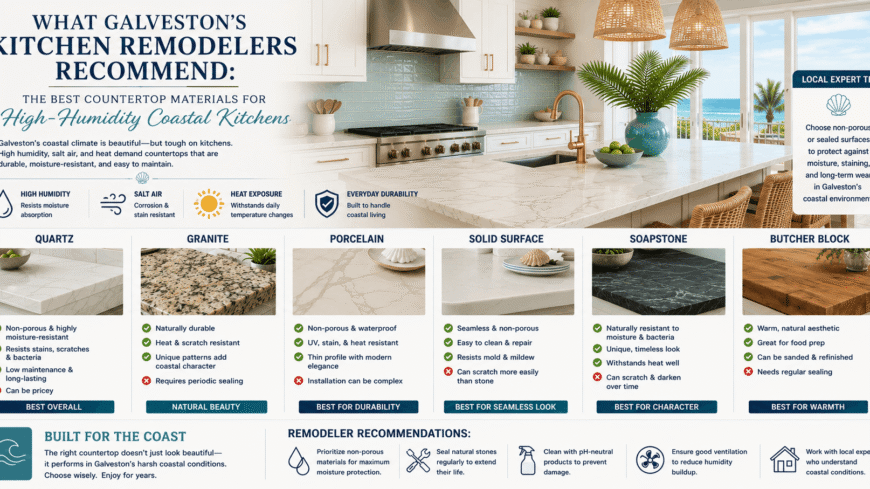
Engineered quartz is the single most recommended countertop material by kitchen remodelers in Galveston for high-humidity applications, and for good reason. Quartz countertops are manufactured from approximately 90 to 95 percent ground quartz aggregate bound with polymer resins — a composition that produces a surface that is:
- Non-porous: Quartz does not absorb moisture, liquids, or bacteria. There is no need for periodic sealing, and humidity cycling has no structural effect on the material.
- Highly stain-resistant: The resin binders create a surface that resists staining from acidic foods, cooking oils, and the kinds of high-traffic use common in beach house kitchens.
- Dimensionally stable: Unlike natural stone, quartz does not micro-crack or expand and contract significantly with temperature and humidity changes.
- Low maintenance: A wipe-down with a mild cleanser is all routine care requires — no annual sealing, no pH-specific cleaners, no special treatment for coastal conditions.
For coastal kitchens, quartz also benefits from a wide range of aesthetic options. The material can be manufactured to mimic the appearance of marble, limestone, or concrete with the durability none of those materials can match in a high-humidity environment. Matte and leathered finish options are increasingly popular in 2026 coastal kitchens because they hide fingerprints and watermarks better than polished surfaces in a busy beach house setting.
One consideration with quartz in a Galveston context: it is not UV stable. Prolonged direct sunlight exposure through windows or open glass doors can cause color shift over time in some quartz products. For kitchens with significant southern or western sun exposure, specifying a UV-stable product or managing exposure through window film is worth discussing with your remodeling team.
Porcelain Slab: The Emerging High-Performance Option
Large-format porcelain slab countertops have moved from a niche specification to a mainstream option over the past several years, and they are particularly well-suited to Gulf Coast kitchens. Porcelain is fired at extremely high temperatures, producing a surface that is:
- Fully vitrified: Porcelain has essentially zero water absorption — typically below 0.5 percent by industry standard, and often lower in countertop-grade products. This makes it one of the most moisture-resistant countertop surfaces available.
- UV stable: Unlike quartz, porcelain does not shift color or degrade under prolonged UV exposure — an important advantage in kitchens with significant natural light or indoor-outdoor connections.
- Heat and scratch resistant: Porcelain’s hardness makes it highly resistant to surface scratching, and it is unaffected by hot pots and pans placed directly on the surface.
- Hygienic: The non-porous surface does not harbor bacteria, mold, or mildew even in persistently humid conditions.
The primary consideration with porcelain slab countertops is fabrication complexity. Large-format porcelain is more brittle than quartz during cutting and installation, which means it requires experienced fabricators with the right equipment. Poorly executed cuts at sink cutouts or cooktop openings are the most common point of failure. Working with experienced kitchen remodelers in Galveston who have established relationships with qualified porcelain fabricators is essential to getting this material right.
Porcelain slabs can be specified in thicknesses from 6mm to 20mm, with thicker options providing better visual weight and edge profile options that read as more substantial in the finished kitchen.
Natural Stone: Beautiful, But Requires Coastal-Specific Selection and Maintenance
Natural stone countertops — marble, quartzite, granite, and limestone — remain highly sought-after in coastal kitchen design for their visual depth and uniqueness. No two slabs are identical, and the organic variation in natural stone produces a richness that engineered materials replicate but do not fully replace.
However, natural stone in a high-humidity coastal environment requires careful material selection and a genuine commitment to maintenance. Not all stone performs equally in Galveston’s conditions:
Quartzite
True quartzite — not to be confused with quartz — is a naturally occurring metamorphic rock formed from sandstone under heat and pressure. It is significantly harder and denser than marble, with lower porosity and better resistance to etching from acidic foods. For coastal kitchens where natural stone is a priority, quartzite is generally the most durable option, provided it is properly sealed on installation and resealed annually.
The challenge with quartzite is that the market is inconsistent — some slabs sold as quartzite are actually softer, more porous marble or dolomitic marble. Sourcing from a reputable supplier and requesting a porosity test before purchase is advisable.
Granite
Granite is a reliable performer in coastal kitchens when properly sealed. Its crystalline structure makes it harder and less porous than marble, and it resists heat well. Annual sealing is required to maintain moisture resistance, and the frequency may need to increase in high-humidity coastal environments where moisture pressure on the slab is constant.
Dark-toned granites with tight grain structures generally outperform light, open-grained options for moisture resistance in Galveston kitchens.
Marble
Marble is calcium-carbonate based, which makes it inherently susceptible to etching from acids — lemon juice, vinegar, wine, and even water with a low pH. In a high-use beach house kitchen, marble countertops require significant lifestyle adjustment and frequent maintenance to maintain their appearance. For Galveston kitchens, marble is best reserved for lower-use surfaces such as a dedicated baking station or island top rather than the primary work surface.
The Marble Institute of America provides detailed guidance on sealing, maintenance, and material selection for natural stone in residential applications — a useful reference for homeowners evaluating stone options.
What Kitchen Remodelers in Galveston Recommend Avoiding
Some countertop materials that are widely installed in inland Texas homes perform poorly in high-humidity coastal conditions and are worth avoiding or approaching with caution:
- Laminate countertops — the particleboard or MDF substrate beneath standard laminate absorbs moisture readily, causing swelling, bubbling, and delamination at seams and edges. In a Galveston kitchen, laminate countertops often fail within five to eight years under normal coastal conditions.
- Unsealed butcher block and wood — wood countertops require rigorous sealing and maintenance in any environment, but in a high-humidity coastal kitchen the moisture cycling demands frequent re-oiling and sealing that many homeowners find impractical. Wood is best reserved for accent sections — a small island or prep surface — rather than primary run countertops.
- Concrete countertops — while visually compelling, concrete is inherently porous and requires substantial sealing to perform in high-humidity environments. It is also susceptible to cracking from the settling movements that coastal soil conditions can produce. Concrete works in coastal kitchens when properly sealed and maintained, but it demands more ongoing attention than quartz or porcelain.
According to the National Association of Home Builders, kitchen countertops rank among the top three components homeowners evaluate when assessing overall kitchen quality and home value — making material selection one of the highest-impact decisions in any remodel.
Edge Profiles and Fabrication Details That Matter in Coastal Kitchens
Beyond material selection, how a countertop is fabricated and finished affects both its durability and maintenance burden in a coastal environment:
- Eased or slightly beveled edges perform better than sharp square edges, which chip more readily in high-use kitchen environments
- Undermount sinks are strongly preferred over drop-in sinks in coastal kitchens — the absence of a rim eliminates the gap between the sink and countertop where moisture accumulates, mold grows, and adhesives fail
- Full-height backsplash integration using the same countertop slab material eliminates the grout joint at the wall-counter transition, removing a common moisture infiltration point that is particularly problematic in high-humidity environments
- Coastal-grade silicone at all seams and penetrations — standard silicone degrades faster in UV-exposed and high-humidity environments; specifying a product rated for coastal or marine applications extends joint life significantly
These fabrication details are part of how Royal Coastal Builders approaches every kitchen remodeling project — getting the specification right down to the details that most homeowners do not think to ask about until something fails.
Choosing the Right Surface for Your Galveston Kitchen
The best countertop for your Galveston kitchen depends on how you use the space, how much maintenance you are willing to commit to, and what your design priorities are. For most coastal homeowners balancing durability, appearance, and low maintenance in a high-humidity environment, engineered quartz and porcelain slab represent the strongest long-term investments. For those willing to commit to the maintenance that natural stone requires, quartzite and granite offer an organic beauty that engineered materials approximate but do not replicate.
What matters most is making this decision with a clear understanding of what Galveston’s climate actually demands from a countertop surface — and working with kitchen remodelers in Galveston who have the experience to guide that decision based on real coastal performance rather than showroom appeal alone.
Ready to choose the right countertop for your Galveston kitchen remodel? Contact Royal Coastal Builders at (409) 996-2273 or visit royalcoastalbuilders.com/contact to schedule a consultation with our kitchen remodeling team today.