
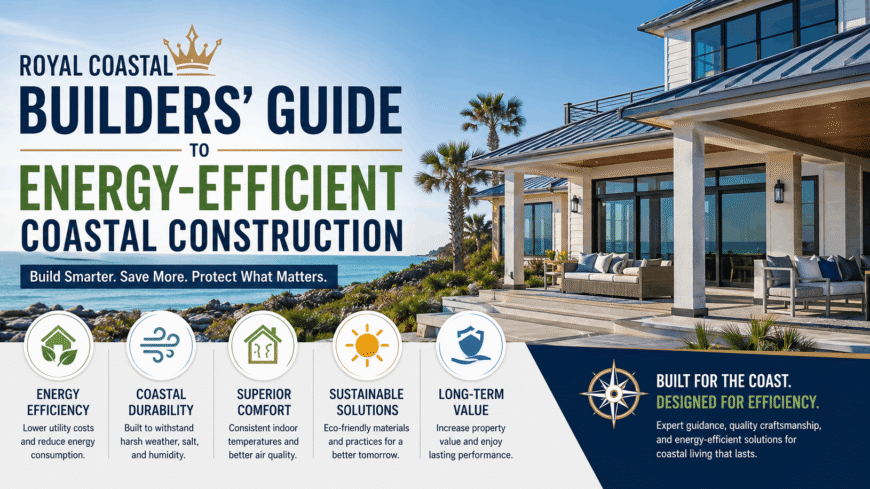
Energy Efficient Home Builders in Galveston: Royal Coastal Builders’ Complete Guide to Coastal Construction
Choosing energy efficient home builders in Galveston is one of the most impactful decisions you can make for your long-term comfort and operating costs. The Gulf Coast is not a forgiving environment for homes that were not designed with energy performance in mind. Galveston summers run long and intensely hot, humidity levels stay elevated year-round, and salt air accelerates deterioration in building materials that were not selected for coastal exposure. A home that performs poorly on energy efficiency in this climate is not just uncomfortable — it is expensive to own, month after month, for as long as you live in it.
At Royal Coastal Builders, energy performance is not an afterthought. It is built into how we design and construct every home from the foundation up. This guide walks you through the construction systems, materials, and strategies we use to deliver genuinely energy-efficient homes on Galveston Island and the Texas Gulf Coast.
What Makes Energy Efficiency Different for Coastal Construction
Inland energy efficiency guidelines were written for different conditions than what Galveston homeowners face. The standard building science recommendations for attic insulation, vapor barriers, and HVAC sizing were developed around inland Texas climates — not a barrier island sitting between the Gulf of Mexico and Galveston Bay.
Coastal construction requires a different approach because:
- Humidity drives moisture into building assemblies in ways that standard insulation and vapor management strategies do not adequately address
- Salt air accelerates material degradation, which means choosing the wrong window seals, exterior cladding, or mechanical systems leads to energy loss as components deteriorate faster than expected
- Wind-driven rain and storm pressure can force water through wall assemblies that pass code inspections in dry climates but fail in Gulf Coast storm conditions
- Elevated home designs create unique thermal envelopes that must be carefully engineered to avoid excessive heat gain from the underside and sides of the structure
Working with energy efficient home builders in Galveston means working with a team that understands these coastal-specific variables and designs for them — not one that applies generic solutions developed for inland markets.
Building Envelope: Where Energy Efficiency Starts
The single most important factor in a home’s energy performance is the quality of its building envelope — the walls, roof, windows, and foundation system that separate the conditioned interior from the outdoor environment. For a Galveston home, envelope performance must address both thermal control and moisture management simultaneously.
Insulation Systems for the Gulf Coast
Standard fiberglass batt insulation is the most commonly used material in residential construction across the country. It performs adequately in dry climates but can be problematic in high-humidity coastal environments where moisture intrusion into wall cavities creates conditions for mold growth and accelerated degradation.
Higher-performing alternatives we use in coastal construction include:
- Closed-cell spray foam insulation — provides both thermal insulation and a vapor barrier in a single application, making it highly effective in Galveston’s humid climate. It also adds structural rigidity to wall assemblies and resists moisture intrusion. Closed-cell foam achieves an R-value of approximately 6.5 per inch, significantly higher than standard batt insulation.
- Rigid foam continuous insulation — applied to the exterior of wall framing to eliminate thermal bridging through studs, which can account for 20 to 25 percent of heat transfer through a standard framed wall
- Spray foam in roof assemblies — applied directly to the underside of the roof deck creates a conditioned attic space, dramatically reducing the thermal load on HVAC systems and protecting ducts from extreme attic temperatures
Windows and Doors for Coastal Energy Performance
Windows and doors are the most vulnerable points in any coastal building envelope — both for energy performance and storm resistance. For Galveston homes, we specify:
- Impact-rated windows with low-E coatings — low-emissivity glass coatings reduce solar heat gain while maintaining natural light, and impact ratings meet coastal wind requirements without the need for separate storm shutters
- Thermally broken frames — aluminum frames with thermal breaks prevent conductive heat transfer through the frame itself
- Proper installation with coastal-grade flashing and sealants — window performance in coastal environments depends as much on correct installation as on product specifications
HVAC Design for a High-Humidity Gulf Coast Climate
Air conditioning accounts for the largest share of energy costs in most Galveston homes, running 8 to 10 months out of the year. How a home’s HVAC system is designed and sized has a direct and lasting impact on both comfort and utility bills.
Common mistakes in coastal HVAC design include:
- Oversized systems that short-cycle, failing to run long enough to adequately dehumidify the air. In Galveston’s humid climate, humidity control is as important as temperature control for indoor comfort.
- Undersized or uninsulated ductwork routed through unconditioned spaces, losing significant cooling capacity before it reaches living areas
- Inadequate fresh air ventilation, creating indoor air quality problems that then require more energy to manage
Our HVAC team designs systems using Manual J load calculations specific to each home’s square footage, orientation, envelope performance, and window area — not rules of thumb that routinely produce the wrong equipment size. We also specify high-efficiency equipment rated for coastal environments, where salt air can degrade standard components more rapidly than manufacturers’ warranties anticipate.
For new construction, we increasingly incorporate energy recovery ventilators (ERVs) that bring in fresh outdoor air while capturing a significant portion of the energy already used to condition indoor air — a meaningful efficiency gain in a climate that requires constant fresh air management.
Roofing Systems That Reduce Cooling Loads
The roof is the primary point of solar heat gain in any Galveston home. A poorly performing roof assembly can add thousands of dollars to annual cooling costs and place excessive demand on HVAC equipment, shortening its useful life.
Our roofing recommendations for energy-efficient coastal homes include:
- Cool-roof rated metal roofing panels with high solar reflectance and thermal emittance values. A properly specified metal roof can reflect up to 70 percent of solar energy, significantly reducing attic and living space temperatures compared to standard dark asphalt shingles.
- Conditioned attic assemblies with spray foam applied to the roof deck underside, eliminating the extreme temperature differentials in vented attic spaces that drive heat into living areas and stress HVAC ductwork
- Light-colored or reflective exterior finishes that reduce radiant heat absorption from wall surfaces
These roofing strategies work together with the insulation and HVAC systems described above to create a whole-building approach to energy performance rather than isolated upgrades that underdeliver because other components were not addressed.
Exterior Materials and Moisture Management
Choosing the right exterior materials for a Galveston home affects both energy performance and long-term durability. Materials that absorb moisture or degrade rapidly in salt air force repeated repairs and replacements that compromise the building envelope over time.
High-performance exterior systems we recommend for coastal energy-efficient construction include:
- Fiber cement siding — dimensionally stable, moisture-resistant, and non-combustible, with excellent long-term performance in Gulf Coast conditions. It does not swell, rot, or provide a substrate for mold in the way that wood-based products can.
- Continuous air barriers installed behind exterior cladding to prevent wind-driven infiltration — a significant source of energy loss in Gulf Coast homes during both summer operation and storm events
- Coastal-grade exterior caulks and sealants at all penetrations, windows, and transitions — standard products break down rapidly in UV-intense, high-humidity environments, creating gaps that allow conditioned air to escape and outdoor air to infiltrate
Moisture management is inseparable from energy performance in coastal construction. A wall assembly that allows moisture to accumulate loses insulation value over time, creates mold risk, and eventually requires invasive repairs. Getting the moisture management details right at the time of construction is far less expensive than addressing failures after the fact.
Plumbing and Electrical Systems That Support Energy Efficiency
Energy efficiency in a coastal home extends beyond the envelope and mechanical systems. How the plumbing and electrical systems are designed and installed contributes to overall energy performance in ways that are often overlooked.
Key considerations include:
- Tankless water heaters — eliminate standby heat loss from traditional tank-style units and provide on-demand hot water that better suits the usage patterns of vacation and coastal homes
- Hot water recirculation systems — reduce water waste and the energy used to heat water that sits in long pipe runs before it reaches fixtures
- LED lighting throughout — dramatically reduces lighting energy loads and heat generation, which reduces cooling demand in a climate where every BTU of internal heat gain must be removed by the air conditioning system
- Pre-wiring for solar and battery storage — new construction is the most cost-effective time to install conduit, panel capacity, and structural roof connections for future photovoltaic systems, even if solar panels are not installed at initial completion
The U.S. Department of Energy’s Building Technologies Office provides extensive guidance on whole-home energy performance standards that inform how we approach systems integration in new coastal construction.
The ENERGY STAR and HERS Rating Framework
Homeowners evaluating energy efficiency claims from builders benefit from understanding objective third-party performance standards. The two most relevant frameworks for new residential construction are:
- ENERGY STAR for New Homes — a certification program administered by the U.S. Environmental Protection Agency that requires third-party verification of insulation, air sealing, HVAC design, and other systems against standards significantly more stringent than minimum code
- HERS Index (Home Energy Rating System) — a numerical score where a lower number indicates better energy performance. A standard new home built to current code scores approximately 100. An ENERGY STAR certified home typically scores below 75. High-performance homes can achieve scores in the 40 to 60 range.
These ratings give you an objective, third-party verified measure of a home’s energy performance that you can use to compare builders and hold your contractor accountable.
When you are evaluating energy efficient home builders in Galveston, asking about HERS ratings and ENERGY STAR certification is one of the most direct ways to assess whether a builder’s energy efficiency claims are backed by verifiable performance standards. The ENERGY STAR program provides a searchable database of certified builders and homes if you want to verify certifications independently.
Building an Energy-Efficient Coastal Home That Performs for Decades
Energy efficiency in a Galveston coastal home is not achieved through a single upgrade or product selection. It requires a whole-building approach that addresses the envelope, mechanical systems, roofing, exterior materials, and site orientation as an integrated system. When these elements are designed and built together by an experienced coastal construction team, the result is a home that stays comfortable, requires less maintenance, and costs significantly less to operate over its full lifespan.
Royal Coastal Builders brings over 50 years of combined experience to every project, with deep expertise in the specific demands of Gulf Coast construction. If you are planning a new home on Galveston Island and want to work with energy efficient home builders in Galveston who design for real coastal performance, we are ready to help.
Contact Royal Coastal Builders at (409) 996-2273 or visit royalcoastalbuilders.com/contact to start the conversation about your energy-efficient coastal home today.